
10 Masterful Midjourney Prompt Examples for 2025
Midjourney has transformed creative workflows, but the quality of your output is directly tied to the quality of your input. A well-crafted prompt is more than just a description; it's a precise set of instructions blending artistic vision with technical parameters. This guide breaks down 10 essential Midjourney prompt examples, moving beyond basic descriptions to reveal the underlying strategies that separate amateur results from professional-grade images.
We will dissect the structure of each prompt, analyzing how elements like subject, style, lighting, composition, and specific Midjourney parameters work in harmony. You will learn not just what to write, but why specific keywords deliver superior outcomes. For those looking to build a deep well of creative ideas, consulting an ultimate drawing prompts list can provide a wide array of categories for endless inspiration.
Whether you're a designer creating assets, a marketer visualizing a campaign, or an artist exploring new styles, mastering these examples will provide a replicable framework for generating consistently stunning visuals. Each breakdown offers a strategic blueprint you can adapt and apply to your own unique creative challenges, turning your abstract ideas into tangible, high-quality images.
1. Portrait Photography with Natural Lighting
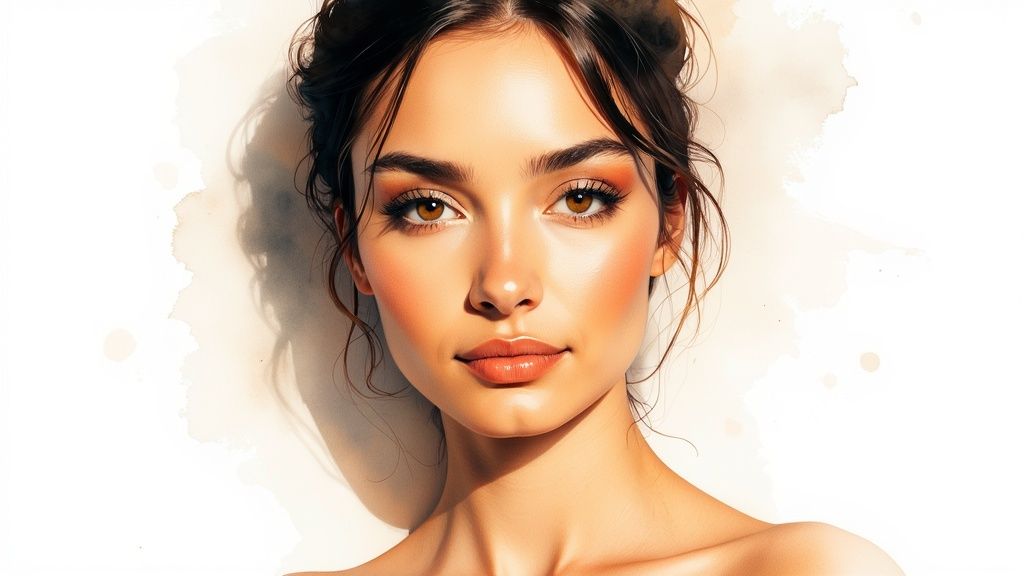
This foundational prompt type is a cornerstone for creating realistic, professional-grade human portraits in Midjourney. It combines a clear subject description with specific artistic and technical instructions, focusing on the quality and direction of light to produce images that are both authentic and visually striking. The core principle is to mimic the nuanced, gentle look of natural light, which is often favored in professional photography for its flattering and dynamic qualities. This approach is highly effective for generating everything from corporate headshots to artistic fashion spreads.
Strategic Breakdown
This type of prompt succeeds by layering details. It moves from a broad subject (portrait of a woman) to specific stylistic choices (natural lighting, soft focus) and technical parameters (50mm lens, --ar 2:3). This method provides Midjourney with a clear hierarchy of instructions, ensuring the most important elements, like the subject and lighting, are prioritized while still incorporating finer details. It's a perfect example of how combining descriptive language with technical commands yields superior control and quality.
Actionable Tips for Implementation
- Specify Lighting: Instead of just "natural light," use more descriptive terms like "golden hour sunlight," "soft window light," or "dappled light through leaves" to control the mood.
- Define the Subject: Be specific with details like "a woman in her early 30s with freckles" or "a man with a confident expression" to guide the AI toward a more precise outcome.
- Incorporate Camera Settings: Add camera and lens specifics like
50mm f/1.8 lensorshot on a Canon EOS R5to enhance realism. - Use Style Parameters: Employ
--style rawfor a more photographic, unopinionated look or--niji 5for an illustrative or anime-influenced portrait.
This is one of the most versatile midjourney prompt examples because it can be adapted for personal branding, content creation, or conceptual art. To dive deeper into how different lighting keywords can transform your images, you can explore a wide variety of lighting prompts. For a comprehensive look at lighting techniques, you can find more inspiration with these Midjourney lighting prompts.
2. Fantasy Landscape with Cinematic Mood
This prompt category focuses on building immersive, atmospheric worlds that feel pulled from a blockbuster film or a high-fantasy video game. The key is to blend fantastical elements with cinematic techniques, using instructions for lighting, camera angles, and mood to create a scene with a strong narrative quality. By treating the AI as a virtual art director, users can generate rich, detailed environments perfect for concept art, book covers, or visual storytelling. This approach moves beyond simple descriptions to orchestrate a complete visual experience.
Strategic Breakdown
The success of these prompts lies in their layered, atmospheric world-building. They start with a core location (ancient ruins on a floating island) and then add specific lighting (ethereal god rays), weather (rolling mist), and cinematic framing (wide-angle shot, cinematic). This method provides Midjourney with a clear sequence of instructions, prioritizing the environment first and then applying stylistic layers on top. It's a powerful way to generate images that not only look fantastic but also evoke a specific emotion or story.
Actionable Tips for Implementation
- Layer the Environment: Build your scene by specifying the location, time of day, and weather separately. For example, "a dark forest during a thunderstorm at twilight."
- Reference Specific Artists: Guide the visual style by including phrases like "in the style of John Howe" or "inspired by the art of FromSoftware games."
- Control the Atmosphere: Add keywords like "mist," "volumetric lighting," "glowing particles," or "lens flare" to introduce dynamic, moody elements.
- Define the Frame: Use technical parameters like
--ar 16:9for a widescreen cinematic look or--ar 9:16for a dramatic vertical shot suitable for phone wallpapers.
This is one of the most effective midjourney prompt examples for creating epic, story-driven visuals. To explore how to refine these cinematic qualities further, you can find a variety of powerful prompts. For more ideas on achieving this look, check out these Midjourney cinematic prompts.
3. Product Design with Lighting and Material Specification
This specialized prompt category is essential for creating commercial-grade product visualizations. It combines precise subject descriptions with explicit material properties, professional lighting setups, and studio photography parameters. The primary goal is to generate images that accurately represent a product's form, texture, and finish, making it invaluable for e-commerce, industrial design, and marketing. This approach allows creators to produce high-fidelity mockups that can replace expensive photoshoots, visualize concepts, and develop compelling advertising materials.
Strategic Breakdown
This prompt type excels by treating the AI as a virtual photographer and materials expert. It breaks down the request into distinct, professional-level components: the product itself, its specific materials (anodized black aluminum), the lighting environment (professional studio lighting), and the camera setup (80mm macro lens). This layered approach provides Midjourney with a detailed blueprint, reducing ambiguity and forcing it to render textures and light reflections with a high degree of realism. It’s a powerful demonstration of how technical vocabulary from design and photography can elevate AI-generated content from artistic interpretation to commercial-grade asset.
Actionable Tips for Implementation
- Specify Lighting and Shadows: Use phrases like "professional studio lighting with a three-point setup" or "softbox lighting" for control. Add "soft shadows" or "no harsh shadows" to define the final look.
- Define Material Finishes: Be highly specific with materials, such as "matte finish plastic," "brushed stainless steel," or "premium grained leather."
- Set the Scene: Provide context with phrases like "on a white marble surface" or "in a user's hand" to add scale and realism.
- Control Composition: Use aspect ratios like
--ar 1:1for social media posts or--ar 3:4for product stacks on e-commerce sites.
As one of the most commercially viable midjourney prompt examples, this technique is perfect for creating digital catalogs, product launch mockups, and packaging designs. To further explore this area, you can find a variety of prompts for Midjourney industrial design.
4. Character Design with Art Style and Personality
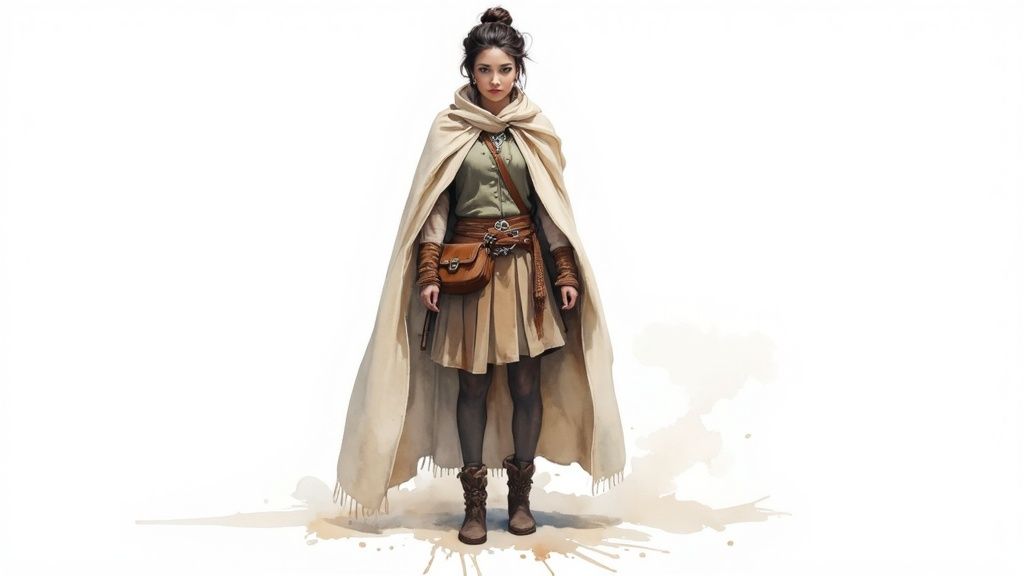
This prompt category is crucial for creating unique, memorable characters for projects like video games, animation, and storytelling. It moves beyond simple descriptions by blending specific artistic styles with deep personality traits, clothing details, and emotional context. The goal is to produce a character that feels fully realized, with a backstory implied through visual cues. This method is fundamental for concept artists and designers who need to establish a consistent and compelling visual identity for their creations.
Strategic Breakdown
The strength of this prompt lies in its multi-layered approach to character definition. It establishes a visual foundation by citing specific art styles (inspired by Studio Ghibli and Overwatch) and then builds upon it with narrative elements like personality (confident expression) and accessories (worn leather backpack). By commanding Midjourney to synthesize these distinct concepts, the prompt generates a character that is more than just a drawing; it’s a cohesive piece of visual storytelling. This makes it one of the most powerful midjourney prompt examples for creative development.
Actionable Tips for Implementation
- Combine Art Styles: Mention multiple visual influences, like "character design in the style of Genshin Impact mixed with classic Disney animation," to generate unique hybrids.
- Describe Personality Through Posture: Use phrases like "powerful stance," "hesitant posture," or "relaxed and approachable" to infuse the character with a specific attitude.
- Detail Key Accessories: Focus on items that tell a story, such as "carrying an ancient, glowing lantern" or "wearing a necklace with a single, cracked pearl."
- Leverage Specialized Models: Utilize
--niji 5for a polished anime or illustrative look or--style expressivefor more emotionally dynamic results. - Request Multiple Views: Generate a character sheet by prompting for "full body front view, profile view, and back view" in sequence to ensure design consistency.
5. Architectural Visualization with Atmospheric Conditions
This specialized prompt type is designed for generating hyper-realistic or conceptual images of buildings and interiors. It fuses precise architectural language with evocative atmospheric details like weather, time of day, and mood. The core idea is to go beyond simple blueprints and create compelling visualizations that tell a story about the space. This technique is invaluable for architects, real estate developers, and interior designers who need to convey not just the structure, but the feeling of a location. It's used for everything from urban development proposals to residential design concepts.
Strategic Breakdown
The strength of this prompt lies in its layered, context-rich commands. It starts with an architectural style (brutalist concrete museum), sets a specific scene (on a cliff overlooking the ocean), and then injects mood through atmosphere (on a misty, overcast morning). This method gives Midjourney clear, hierarchical instructions, allowing it to build a complex scene piece by piece. Combining architectural terminology with sensory details ensures the final image is both structurally sound and emotionally resonant, a hallmark of effective architectural visualization.
Actionable Tips for Implementation
- Specify Style: Be explicit with terms like "brutalist architecture," "biophilic design," or "inspired by Zaha Hadid" to define the aesthetic.
- Define Atmosphere: Use vivid descriptors like "blue hour dusk," "rain-slicked streets," or "warm afternoon sun" to control the environment's mood.
- Set the Viewpoint: Guide the camera with phrases such as "street-level view," "aerial drone shot," or "interior perspective looking out a window."
- Add Human Scale: Include elements like "people walking with umbrellas" or "a single person reading on a balcony" to give a sense of scale and life.
These architectural midjourney prompt examples are crucial for creating professional-grade presentations. While Midjourney excels at generating visuals, exploring broader discussions on the top AI applications for interior design can provide a wider context for enhancing your visualization projects.
6. Food and Culinary Photography with Styling
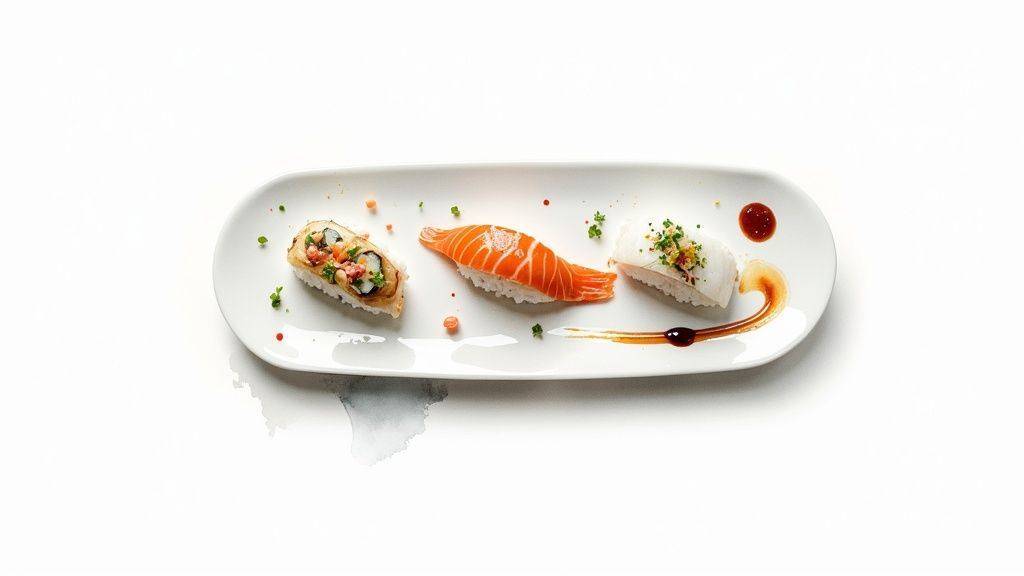
This specialized prompt type is engineered for creating hyper-realistic and appetizing food imagery, crucial for culinary marketing, food blogging, and restaurant media. It moves beyond simply naming a dish by incorporating detailed descriptions of ingredients, plating design, contextual styling, and specific lighting. The goal is to evoke a sensory experience, making the food look as delicious and professionally prepared as it would in a high-end magazine photoshoot. This approach is invaluable for generating stunning visuals for menus, social media, and recipe apps.
Strategic Breakdown
The effectiveness of this prompt lies in its multi-sensory and detailed construction. It starts with the core subject (a gourmet burger) and then layers on specific visual and textural cues (glistening brioche bun, melted cheddar cheese). By adding professional styling elements (on a rustic wooden board, garnished with microgreens) and specific lighting (warm, soft sidelight), the prompt gives Midjourney a complete scene to render, not just an object. This structured approach ensures a high level of detail and commercial-quality finish.
Actionable Tips for Implementation
- Specify Plating and Setting: Use phrases like "Japanese kaiseki presentation," "on a white ceramic plate," or "served on a slate platter with a linen napkin" to define the context.
- Describe Lighting Warmly: Enhance the mood with lighting cues such as "warm golden hour sidelight," "soft diffused window light," or "dramatic chiaroscuro lighting."
- Add Freshness Cues: Incorporate details that imply temperature and texture, like "steam rising from the soup," "glistening with olive oil," or "chilled with condensation droplets."
- Set the Aspect Ratio: Use
--ar 1:1for social media posts like Instagram or--ar 4:5for a more traditional food photography composition.
This is one of the most commercially valuable midjourney prompt examples because it directly serves the needs of the massive food and beverage industry. It's a powerful tool for creating high-quality, cost-effective visual content that drives appetite appeal.
7. Illustration with Narrative and Emotional Context
This advanced prompt category elevates AI-generated images from simple depictions to compelling visual stories. It moves beyond describing what is in the scene to defining why it matters by infusing the prompt with narrative tension, emotional weight, and a specific artistic voice. The goal is to create illustrations that feel like a single, meaningful frame from a larger story, making it perfect for book covers, children's book pages, or editorial artwork where conveying a feeling or a moment is paramount. This method transforms the AI into a co-author, not just a renderer.
Strategic Breakdown
The power of this prompt structure lies in its layering of abstract concepts over concrete descriptions. It starts with an emotional core (a moment of quiet realization), adds a narrative context (a lone traveler discovering a hidden city), and then layers on a specific artistic style (in the style of Studio Ghibli, textured watercolor). This combination guides Midjourney to not only render the scene but also to capture the intended mood and atmosphere, resulting in an image with far greater depth and resonance than a purely descriptive prompt could achieve.
Actionable Tips for Implementation
- Lead with Emotion: Start your prompt with feeling words like "a melancholic farewell," "a hopeful new beginning," or "a tense, uncertain standoff" to set the emotional tone.
- Specify Artistic Influence: Name-drop specific artists or styles to guide the aesthetic, such as "inspired by Arthur Rackham's fairytale illustrations" or "reminiscent of Moebius's sci-fi comics."
- Describe Narrative Tension: Include phrases that imply a story, like "just before the storm," "a secret being shared," or "an unexpected discovery."
- Use Illustrative Parameters: Command Midjourney with
--style expressiveor--niji 5to lean into an illustrative, stylized, and emotionally rich aesthetic.
As one of the more sophisticated midjourney prompt examples, this technique is ideal for creators who want to build worlds and evoke powerful feelings. It allows for the creation of unique, story-driven visuals that stand out in a sea of generic AI art.
8. Fashion Design with Fabric and Detail Specification
This specialized prompt is crucial for visualizing detailed apparel concepts, moving beyond simple clothing descriptions to articulate specific garment silhouettes, fabric textures, and construction details. It serves as a digital mannequin for fashion designers, brands, and marketers, allowing for rapid prototyping of design ideas without the need for physical samples. The core idea is to provide Midjourney with a complete "tech pack" of information, from the material's weight and drape to the model's stance, enabling the AI to generate highly specific and professional fashion imagery.
Strategic Breakdown
The strength of this prompt type lies in its structured layering of fashion-specific terminology. It starts with a base garment (a flowing evening gown) and methodically adds layers of detail, including fabric (heavy crepe), construction techniques (hand-stitched details), and styling context (sleek hair, minimal makeup). This hierarchical approach mirrors the actual design process, guiding the AI from a broad concept to a polished, marketable image. By combining aesthetic descriptors with technical specifications, it bridges the gap between creative vision and tangible output.
Actionable Tips for Implementation
- Specify Fabric Weight and Drape: Use phrases like "heavy crepe, flowing" or "stiff taffeta, architectural" to dictate how the garment falls and holds its shape.
- Include Construction Techniques: Add details such as "hand-stitched beading," "laser-cut edges," or "asymmetrical draping" for greater realism and complexity.
- Reference Designer Aesthetics: Guide the overall mood by mentioning a specific style, like "in the style of Rei Kawakubo minimalism" or "maximalist like Alexander McQueen."
- Define Proportions: Use
–ar 2:3for a standard full-body fashion shot and explicitly state lengths like "cropped at the waist" or "floor-length."
This is one of the more advanced midjourney prompt examples for commercial use, ideal for developing brand lookbooks, forecasting trends, or visualizing sustainable fashion concepts. It empowers creators to bring intricate designs to life with precision and speed.
9. Scientific Visualization and Concept Illustration
This advanced prompt type bridges the gap between scientific accuracy and artistic representation, enabling the creation of detailed educational and professional visuals. It focuses on translating complex concepts, from biological processes to abstract data, into clear, aesthetically pleasing illustrations. The core goal is to generate images that are both informative and visually engaging, making them suitable for textbooks, museum displays, and research presentations. This approach is invaluable for science communicators, educators, and researchers who need to convey intricate information with precision and clarity.
Strategic Breakdown
This prompt category thrives on technical specificity and layering instructional commands. It starts with a core scientific subject (a neuron transmitting a signal) and builds upon it with stylistic directives (medical illustration style, glowing neural pathways) and perspective cues (cross-sectional view). This structured approach ensures Midjourney prioritizes scientific representation while adhering to a specific visual aesthetic, such as that of a journal or a natural history museum. The combination of precise terminology and artistic direction is key to producing high-quality, accurate visuals.
Actionable Tips for Implementation
- Prioritize Accuracy: Begin your prompt with phrases like "biologically accurate illustration of..." or "schematic diagram showing..." to set a foundation of technical correctness.
- Define the Viewpoint: Use specific perspectives to control the composition, such as "cross-sectional view," "magnified 1000x," or "molecular model view."
- Specify the Style: Guide the aesthetic by requesting styles like "medical textbook illustration," "natural history museum aesthetic," or "scientific journal infographic."
- Control Color and Detail: Use descriptive keywords like "vibrant, color-coded diagram" for clarity or "photorealistic microscopic detail" for realism.
This is one of the more specialized midjourney prompt examples, perfect for creating educational content, professional graphics, or detailed concept art. It allows users to visualize the unseen and explain the complex in a compelling way.
10. Abstract and Surreal Artwork with Color and Texture
This creative prompt category moves beyond realistic depiction to explore non-representational, dreamlike imagery. It focuses on evoking emotions and ideas through the interplay of color, texture, and form. The core principle is to guide Midjourney using conceptual language rather than literal descriptions, referencing artistic movements, emotional states, and sensory details. This approach is ideal for creating unique visuals for album covers, fine art portfolios, or any project that requires a high degree of artistic interpretation and emotional impact.
Strategic Breakdown
The success of this prompt type lies in its use of abstract language and artistic references. Instead of describing a scene, the prompt layers concepts like feelings of growth, artistic styles like Jackson Pollock meets Wassily Kandinsky, and textural details like thick impasto oil painting. This layered, conceptual approach gives Midjourney creative freedom within a defined emotional and stylistic framework. It prioritizes mood and composition over literal accuracy, resulting in deeply expressive and original artwork.
Actionable Tips for Implementation
- Start with Emotional Intent: Begin your prompt with the feeling you want to convey, such as "an exploration of digital chaos" or "a visual representation of serenity."
- Reference Artists and Movements: Combine styles for unique results, like "surrealism of Salvador Dalí with the color palette of Georgia O'Keeffe."
- Specify Texture and Medium: Use descriptive terms like "glossy resin pour," "granular digital noise," or "etched lines on metal" to dictate the final surface quality.
- Control Creative Freedom: Use
--chaos 100for wildly unpredictable and varied compositions or--chaos 0to maintain consistency across a theme.
This is one of the most powerful midjourney prompt examples for artists and designers looking to push creative boundaries. It’s perfect for generating unique assets for NFT collections, interior wall art, or wellness app visuals.
Comparison of 10 Midjourney Prompt Examples
| Approach | 🔄 Implementation Complexity | ⚡ Resource Requirements | ⭐📊 Expected Outcomes | 📊 Ideal Use Cases | 💡 Key Advantages / Tips |
|---|---|---|---|---|---|
| Portrait Photography with Natural Lighting | 🔄🔄 — moderate photographic knowledge; iterative tweaks | ⚡⚡ — prompt detail + reference images | ⭐⭐⭐ — consistent professional-looking portraits | LinkedIn headshots; fashion portfolios; branding photos | 💡 High-quality commercial output; specify age/ethnicity, lighting, camera |
| Fantasy Landscape with Cinematic Mood | 🔄🔄🔄 — layered environment + narrative control | ⚡⚡ — art references, aspect ratio, iterations | ⭐⭐⭐ — dramatic, immersive concept art | Game environments; book covers; film pre-vis | 💡 Great for worldbuilding; layer location/time/weather and use director refs |
| Product Design with Lighting & Materials | 🔄🔄🔄 — precise material/finish specification needed | ⚡⚡⚡ — material refs, studio lighting params, post-process | ⭐⭐⭐ — clean product mockups; may need retouch for accuracy | E‑commerce assets; prototyping; marketing mockups | 💡 Rapid iterations and consistent styling; include scale refs and exact materials |
| Character Design with Art Style & Personality | 🔄🔄 — many visual attributes but iterative | ⚡⚡ — style refs and multiple angles helpful | ⭐⭐⭐ — strong character concepts; occasional anatomical errors | Game assets; animation model sheets; tabletop portraits | 💡 Fast exploration of personalities; use multiple references and specify posture |
| Architectural Visualization with Atmospheric Conditions | 🔄🔄🔄 — technical perspective and material detail | ⚡⚡⚡ — site/context refs, aspect ratios, scale figures | ⭐⭐⭐ — compelling pre‑visualization; not CAD‑precise | Real estate listings; client presentations; urban proposals | 💡 Cost‑effective concept visuals; specify viewpoint, scale people, and era/style |
| Food & Culinary Photography with Styling | 🔄🔄 — focused on plating, texture, lighting | ⚡⚡ — styling cues, close‑up lighting references | ⭐⭐⭐ — appetizing visuals when textures render well | Menus; food blogs; social media; recipe apps | 💡 Saves photography time/cost; specify plating, steam, and tableware |
| Illustration with Narrative & Emotional Context | 🔄🔄🔄 — composition + emotional direction required | ⚡⚡ — art style refs and narrative beats | ⭐⭐⭐ — emotionally resonant illustrations; may need direction | Children’s books; editorial art; graphic novels | 💡 Strong storytelling potential; lead with emotional intent and composition notes |
| Fashion Design with Fabric & Detail Specification | 🔄🔄🔄 — detailed garment construction and drape | ⚡⚡ — fabric refs, model demographics, aspect ratios | ⭐⭐⭐ — useful concept visuals; fit/drape may need refinement | Collection presentations; trend forecasting; virtual try‑on | 💡 Rapid concept iteration; specify fabric weight, cut, and proportions |
| Scientific Visualization & Concept Illustration | 🔄🔄🔄 — requires domain accuracy and clarity | ⚡⚡⚡ — expert refs, precise labels, validation | ⭐⭐ — clear explanatory visuals but risk of inaccuracies | Textbooks; presentations; museum graphics; medical illustrations | 💡 Effective for education; prioritize scientific refs and request specific perspectives |
| Abstract & Surreal Artwork with Color & Texture | 🔄🔄 — creative intent over technical constraints | ⚡ — low asset needs; experimentation heavy | ⭐⭐ — high creative variety; results subjective and variable | Fine art; album covers; NFTs; decorative art | 💡 Maximizes creativity; use artist refs and --chaos for desired unpredictability |
Key Takeaways: Your Blueprint for Advanced Prompting
This extensive collection of Midjourney prompt examples serves as more than just a creative gallery; it is a strategic blueprint for transforming your ideas into visually stunning realities. The journey from a basic concept to a masterful AI-generated image is paved with intentionality and precision. As we've explored through portraiture, landscapes, product design, and more, the most impactful results emerge not from chance but from a structured and thoughtful approach to prompt engineering.
The recurring theme across all these examples is the power of layered specificity. Simply asking for a "fantasy castle" yields generic results. But asking for a "Gothic revival fortress, perched on a misty cliffside at twilight, volumetric lighting piercing through the fog, cinematic, hyper-detailed, --ar 16:9" gives Midjourney the specific architectural, atmospheric, and technical instructions needed to create a masterpiece.
The Director's Mindset: Your Core Strategy
The most crucial takeaway is to adopt the mindset of a director, a photographer, and an artist all at once. Every word in your prompt is a command to your digital crew.
- You are the Director: You set the scene, define the narrative, and establish the emotional tone. Use terms like "cinematic," "wide-angle shot," or "intimate close-up" to guide the overall composition and feeling.
- You are the Cinematographer: You control the light. Describing "soft morning light," "dramatic volumetric lighting," or "neon-drenched cityscape" has a profound impact on the final image's mood and realism.
- You are the Art Director: You choose the style. Whether it's "style of Annie Leibovitz," "Art Deco illustration," or "3D octane render," specifying an artistic influence provides a powerful stylistic framework.
Actionable Next Steps for Prompt Mastery
To truly elevate your skills, move beyond simply copying and pasting. Instead, deconstruct and reconstruct these Midjourney prompt examples to understand the function of each component.
- Isolate and Iterate: Take a prompt from this list and change only one element at a time. Swap the lighting condition, alter the art style, or change the aspect ratio. This methodical process is the fastest way to learn how each parameter influences the outcome.
- Build Your Lexicon: Start a personal "dictionary" of powerful keywords. Collect terms for lighting (e.g., crepuscular rays, rim lighting), camera lenses (e.g., 35mm, 85mm portrait lens), materials (e.g., brushed aluminum, polished marble), and artistic styles. This will become your creative toolkit.
- Embrace the Unexpected: Don't be afraid to combine seemingly disparate concepts. A "bioluminescent Art Nouveau character" or a "brutalist architectural design made of candy" can lead to groundbreaking and unique visual territories. The AI thrives on novel combinations.
By applying these structured, strategic approaches, you are no longer just a user of Midjourney; you become a true creator. You are building a repeatable process for translating complex creative visions into tangible, high-quality digital art, moving beyond simple generations to craft intentional, compelling, and memorable work.
Ready to explore thousands of high-quality Midjourney prompt examples and see what the world's top creators are building? Join the community at PromptDen to discover, share, and sell prompts, and take your creative workflow to the next level. Find your next masterpiece at PromptDen today.