
12 Best AI Tools for Marketers to Use in 2025

The marketing landscape is evolving at an unprecedented pace, with AI-powered tools no longer being a luxury but a necessity for staying competitive. From automating repetitive tasks to unlocking deep audience insights and personalizing customer journeys at scale, AI is revolutionizing how we approach SEO, content creation, advertising, and analytics. However, the sheer volume of new tools launching daily can feel overwhelming, making it difficult to separate genuine game-changers from fleeting trends.
This guide cuts through the noise. We provide a detailed, hands-on review of the best AI tools for marketers to help you build a smarter, more efficient marketing engine for 2025. We move beyond generic feature lists to give you practical implementation advice, honest assessments of each platform's pros and cons, and real-world use cases. Our goal is to help you find the right solutions for your specific needs, whether you're a prompt engineer, content creator, SEO specialist, or developer. For those focused specifically on search optimization, you may also find value in dedicated resources like the 12 Best AI SEO Tools That Actually Drive Results (2025) guide.
In this comprehensive listicle, you will discover platforms and marketplaces that solve critical marketing challenges. Each entry includes direct links and screenshots, detailing core features, pricing, and integration tips for tools like PromptDen, HubSpot's App Marketplace, and the OpenAI GPT Store. We will show you precisely how to integrate these tools into your workflows for SEO, content strategy, social media management, and data analysis to achieve measurable results.
1. PromptDen
PromptDen establishes itself as a foundational resource and one of the best AI tools for marketers by transforming how we create, share, and utilize AI prompts. It’s not merely a library; it's a comprehensive ecosystem designed to accelerate and monetize prompt engineering across diverse AI models, including text generators like ChatGPT, Gemini, and Claude, and image platforms like Midjourney and DALL·E.
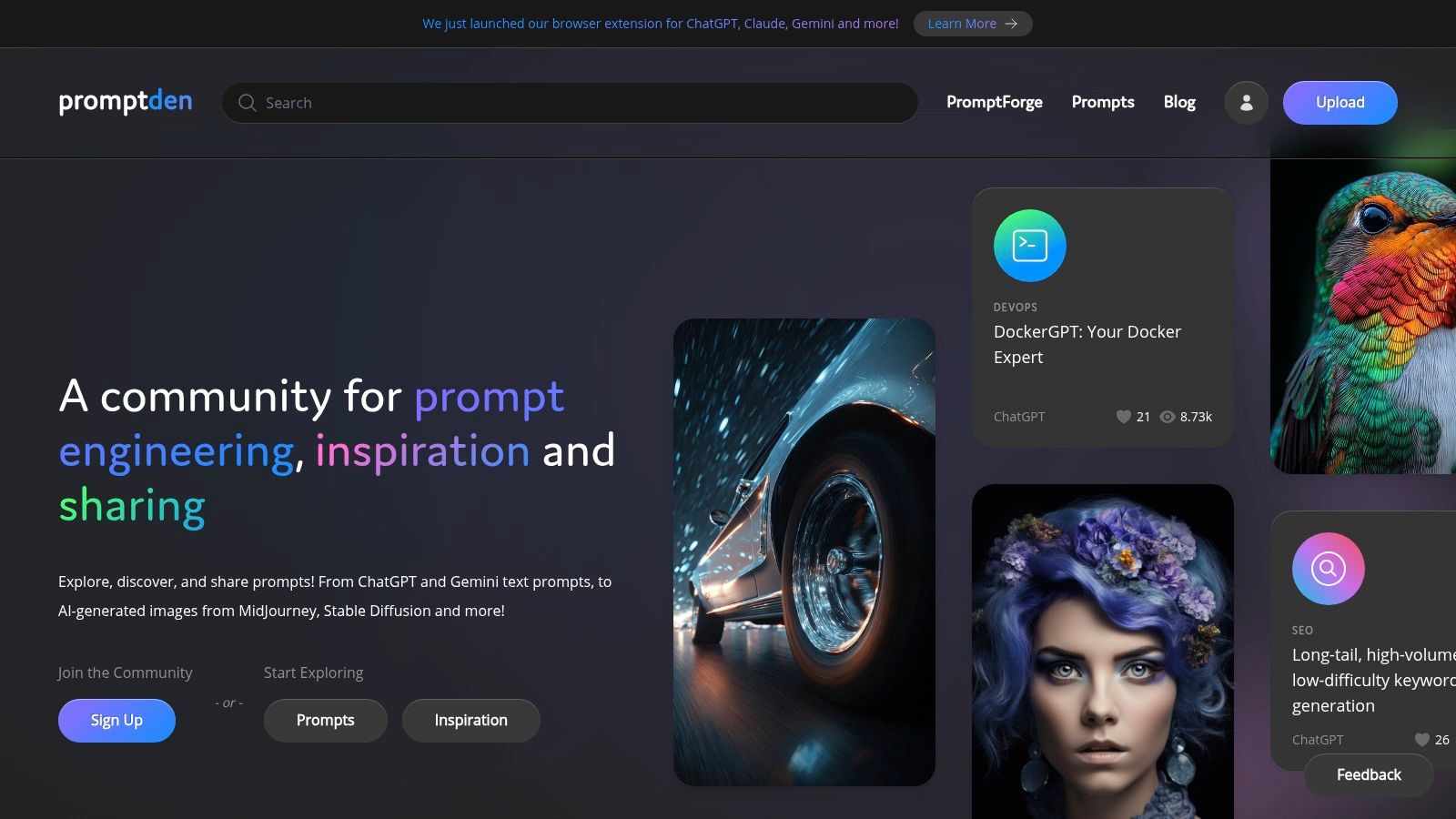
What makes PromptDen a standout choice is its dual focus on community-driven discovery and professional tooling. Marketers can bypass the tedious trial-and-error phase of prompt creation by accessing a vast collection of proven, user-rated prompts for everything from SEO keyword clustering to generating social media content calendars. The visible engagement metrics, with some prompts showing over 260,000 interactions, offer immediate social proof of their effectiveness in real-world campaigns.
Key Strengths & Use Cases
- Cross-Model Versatility: Its standout feature is the support for a wide array of AI systems. A marketer can find a high-performing prompt for a blog post outline on ChatGPT, then immediately pivot to discover a trending Midjourney prompt for the article's hero image, all within a single platform.
- Workflow Integration: The platform’s browser extensions are a significant productivity booster. They allow you to inject prompts from the library directly into your ChatGPT, Gemini, or Claude interface for instant testing and refinement, seamlessly blending discovery with application.
- Monetization & Expertise: The built-in marketplace provides a venue for expert prompt engineers to sell their creations. This creates an environment where marketers can purchase high-quality, pre-vetted prompt workflows for specialized tasks like creating complex ad copy variations or detailed market analysis reports.
- Rapid Prototyping: The PromptForge tool is invaluable for quickly iterating on prompt ideas, helping marketing teams develop and standardize their own proprietary prompts for consistent brand voice and output quality.
Website: https://promptden.com
| Pros | Cons |
|---|---|
| Broad AI model support (text, image, video). | Community-sourced quality can be inconsistent. |
| Marketplace for buying/selling professional prompts. | No transparent, sitewide pricing structure. |
| Browser extensions for direct workflow integration. | Marketplace items require individual vetting. |
| Strong community engagement provides social proof. |
Ultimately, PromptDen is an indispensable launchpad for any marketer looking to elevate their AI-driven content and strategy. Its combination of a high-volume community library, professional tools, and a marketplace for specialized assets makes it a uniquely powerful and versatile solution.
2. G2
While not an AI tool itself, G2 is an indispensable starting point for any marketer building their AI technology stack. It’s a comprehensive B2B software marketplace that provides verified user reviews, detailed comparisons, and category rankings. For those navigating the crowded landscape of the best AI tools for marketers, G2 acts as a crucial, unbiased filter.
Its strength lies in its meticulously organized taxonomy, which is actively updated with emerging AI categories like AI Sales Development Representatives (SDRs) and AI agents. This ensures you're always exploring the most current and relevant software.
Key Features & Use Cases
- Verified User Reviews: Access thousands of in-depth reviews from real B2B users, filtered by company size, role, and industry.
- Side-by-Side Comparisons: Use the comparison feature to create matrices that evaluate tools on specific features, pricing models, and user satisfaction scores.
- Curated "Best Of" Lists: Quickly generate a shortlist by consulting G2's editorial guides and "Grid Reports," which rank top performers in categories like AI Writing Assistants or Social Media Management.
Pricing and Access
G2 is free for buyers to browse reviews, create comparisons, and read reports. Vendors pay for premium profile features and sponsored placements.
Pros and Cons
| Pros | Cons |
|---|---|
| Current Market Coverage: Robust, up-to-date listings of new and emerging tools. | Incomplete Pricing: Not all pricing is listed; often requires a click-through to the vendor's site. |
| Helpful Curation: Editorial lists provide a fast way to surface top tools. | Sponsored Placements: Paid listings can influence visibility, so be sure to check organic results. |
Website: https://www.g2.com
3. Capterra
Similar to G2, Capterra serves as a critical directory for marketers researching software, but with a strong emphasis on user-friendliness and clear pricing information. It excels at providing high-level overviews and quick comparisons, making it an ideal resource for marketers who need to quickly create a shortlist of the best AI tools for marketers based on budget and core functionality.
Capterra's buyer guides and editorial roundups are particularly useful, often breaking down complex AI categories like social media or email marketing automation into digestible snapshots. This approach helps non-technical users understand the value proposition of different AI tools without getting lost in jargon.
Key Features & Use Cases
- Editorial "Best Tools" Guides: Leverage Capterra's curated lists, which often include a clear methodology and recent user ratings to guide your selection process.
- Price Breakdowns: Quickly view pricing tiers and plan features for popular applications, saving time on initial budget assessments.
- Free & Freemium Filters: Efficiently narrow your search to tools that offer free trials or freemium plans, allowing you to test solutions before committing.
Pricing and Access
Capterra is free for software buyers. Vendors pay for listings and other promotional opportunities on the platform.
Pros and Cons
| Pros | Cons |
|---|---|
| Clear Pricing Callouts: Provides helpful price ranges and tier details where available. | Varying Coverage Depth: The level of detail can be inconsistent across different product categories. |
| User-Friendly Resources: Content is geared toward non-technical users, making it easy to understand. | Content Lag: Some product information may not reflect the very latest software updates. |
Website: https://www.capterra.com
4. Product Hunt
For marketers who want to stay on the absolute bleeding edge, Product Hunt is the daily destination. It's a community-driven launch platform where new tech products, including a massive number of AI applications, are showcased every day. By monitoring its daily leaderboards, marketers can discover the best AI tools for marketers often weeks or months before they hit the mainstream.
It serves as a real-time pulse of the market, revealing emerging trends in AI-powered copywriting, ad creation, research, and analytics. The community-centric model provides raw, unfiltered feedback and questions directly from early adopters, offering immediate insight into a new tool's practical value and potential limitations.

Key Features & Use Cases
- Daily Launches: Discover brand new AI marketing apps every single day, from niche GPTs and Chrome extensions to full-fledged platforms.
- Community Feedback: Read comments and reviews from an engaged community of makers and tech enthusiasts to gauge initial reactions and identify potential use cases.
- Curated Collections: Explore topic-specific pages and user-created collections focused on AI, marketing, and SEO to find tools relevant to your needs.
Pricing and Access
Product Hunt is completely free to browse, comment, and discover new products. The tools listed on the platform have their own individual pricing models.
Pros and Cons
| Pros | Cons |
|---|---|
| Discover Emerging Tools: The fastest place to spot newly launched AI marketing tools. | Tool Immaturity: Early-stage products may be buggy or have limited features. |
| Real-World Feedback: Community comments provide valuable, real-world early feedback. | Volatile Pricing: Pricing and capabilities can change quickly after the initial launch. |
Website: https://www.producthunt.com
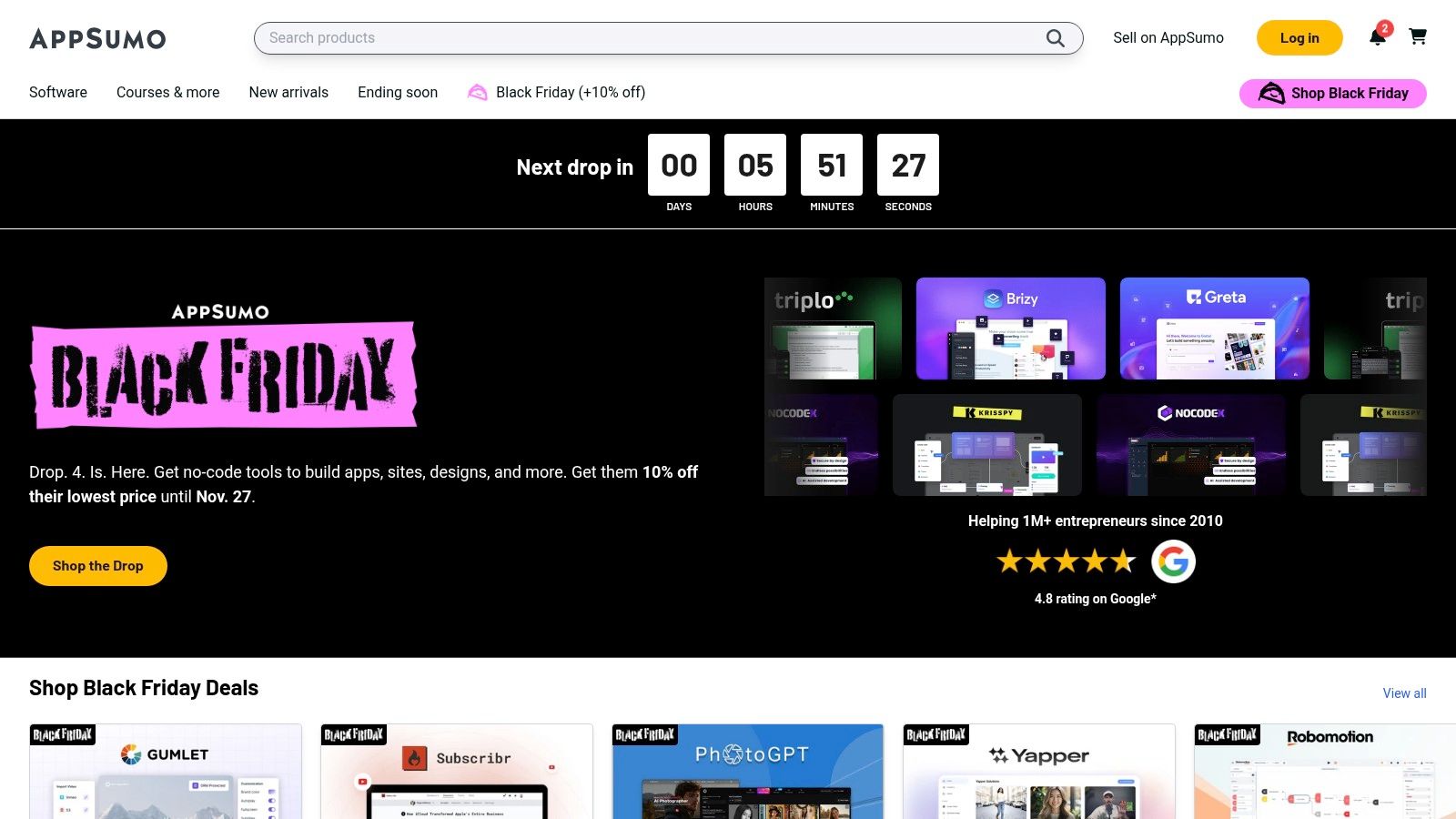
5. AppSumo
For budget-conscious marketers looking to experiment with multiple AI tools, AppSumo is a vital resource. It’s a deal marketplace renowned for offering lifetime deals (LTDs) on emerging software, including a vast selection of AI-powered applications for content generation, SEO analysis, social media management, and AI agent creation. It serves as an excellent discovery platform to test some of the best AI tools for marketers without committing to expensive monthly subscriptions.
The core value for marketing teams lies in the ability to acquire a suite of specialized AI tools for a one-time, low cost. This model significantly reduces the financial risk of building an AI stack, allowing for broader experimentation to find the perfect solutions for your specific workflow needs.
Key Features & Use Cases
- Lifetime Deal Format: Pay once to get lifetime access to software, making it a cost-effective way to build a diverse marketing toolkit.
- Generous Refund Window: Most deals come with a 60-day money-back guarantee, allowing you to thoroughly test a tool and ensure it meets your needs before committing.
- Community Reviews & Questions: Each deal page features an active Q&A section and user reviews, providing real-world insights into a tool’s performance and limitations.
Pricing and Access
AppSumo's model is based on one-time payments for lifetime or annual deals, with prices varying significantly per tool. Browsing the marketplace is free, and they offer a premium membership called AppSumo Plus for additional discounts.
Pros and Cons
| Pros | Cons |
|---|---|
| Low Entry Cost: Access powerful AI tools for a fraction of their standard SaaS price. | Higher Vendor Churn Risk: Some startups may pivot, change terms, or shut down post-deal. |
| Risk-Free Experimentation: The refund policy allows you to vet tools without financial penalty. | Limited Support: Enterprise-level support and SLAs are often not included in lifetime deals. |
Website: https://appsumo.com
6. HubSpot App Marketplace
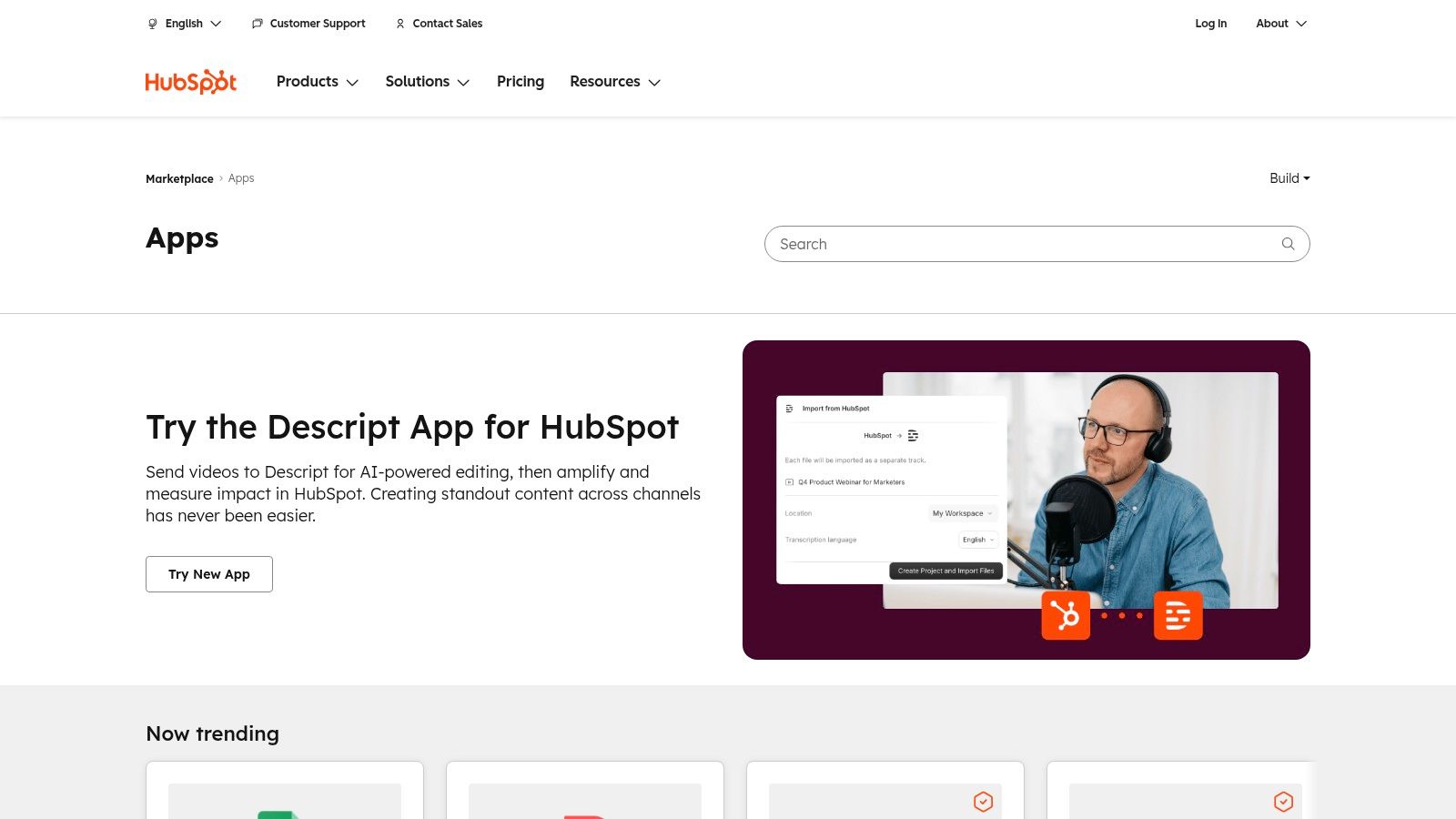
For marketing teams already embedded in the HubSpot ecosystem, the HubSpot App Marketplace is less of a discovery platform and more of a native enhancement hub. It serves as the primary destination for augmenting your Marketing Hub with specialized AI applications and, more recently, Breeze AI agents designed for seamless integration. This makes it one of the best AI tools for marketers who prioritize workflow continuity over standalone solutions.
Its core value is the deep, native connection to your CRM data. Apps found here are built to interact directly with your contacts, campaigns, and reporting, eliminating the clunky data syncing required with external tools. The marketplace also features curated collections, simplifying the search for apps that solve specific marketing challenges, from lead enrichment to content creation.
Key Features & Use Cases
- Breeze Agents: Deploy AI agents directly within HubSpot for specific tasks like generating prospecting emails, drafting social media posts, or creating summaries of customer calls.
- Curated AI Collections: Browse bundles of recommended AI apps tailored for specific marketing functions like content strategy, lead management, and campaign optimization.
- Detailed Integration Information: Each app listing clearly outlines which HubSpot plan is required for use and provides transparent information on vendor pricing and subscription models.
Pricing and Access
Access to browse the marketplace is free, but using the apps requires an active HubSpot account. Many apps also require a separate paid subscription with the third-party vendor. App functionality and availability are often tied to your specific HubSpot plan (e.g., Starter, Professional, Enterprise).
Pros and Cons
| Pros | Cons |
|---|---|
| Native Integration: Apps connect seamlessly with HubSpot data for smoother workflows. | HubSpot Dependent: Useless for teams not using the HubSpot platform. |
| Tailored AI Agents: Breeze Agents are specifically designed for common HubSpot marketing tasks. | Tiered Availability: Feature access can vary significantly depending on your HubSpot plan level. |
Website: https://ecosystem.hubspot.com/marketplace/apps
7. Shopify App Store
For ecommerce and direct-to-consumer businesses, the Shopify App Store is a specialized ecosystem where marketers can find AI tools purpose-built for their platform. Instead of a general marketplace, this is a focused directory of apps designed for one-click integration into a Shopify store, covering everything from ad creative generation to SEO optimization and personalized email campaigns. This makes it one of the best AI tools for marketers operating within the Shopify environment.
Its value lies in the native integration and consolidated billing. Apps are vetted and reviewed by fellow Shopify merchants, providing a layer of social proof that is highly relevant to a store owner's specific challenges, such as cart abandonment, customer segmentation, and product recommendation.

Key Features & Use Cases
- Purpose-Built AI Marketing Apps: Discover tools for campaign creation, AI-powered SEO, ad management, email marketing, and analytics, all designed to work with Shopify data.
- Merchant Reviews & Ratings: Vet potential apps using detailed reviews and ratings from a community of actual Shopify store owners, ensuring the tools solve real-world ecommerce problems.
- Native Integrations: Apps often connect directly with essential marketing platforms like Meta, Google Ads, Klaviyo, and Google Analytics 4, streamlining workflows and data sync.
Pricing and Access
Access to browse the App Store is free for all Shopify merchants. Each app has its own pricing model, which can range from free plans to tiered subscriptions, all conveniently billed through your primary Shopify account.
Pros and Cons
| Pros | Cons |
|---|---|
| One-Click Installs: Seamless integration and consolidated billing through Shopify simplifies tech stack management. | Variable App Quality: The maturity and quality of apps can vary; thorough vetting is recommended before scaling. |
| Relevant Social Proof: Ratings and reviews from other Shopify merchants provide highly contextual insights. | Premium Pricing: The most robust and effective AI apps can be costly, especially for small businesses. |
Website: https://apps.shopify.com
8. Salesforce AppExchange
For marketing teams deeply embedded in the Salesforce ecosystem, the AppExchange isn't just a marketplace; it's a critical hub for extending capabilities with AI. While it serves the entire Salesforce platform, its curated collections for marketing offer powerful, AI-enhanced apps for attribution, personalization, and campaign management that integrate natively with your Sales and Marketing Cloud data. This makes it one of the best AI tools for marketers who prioritize deep CRM alignment and enterprise-grade security.
Its real value lies in providing vetted solutions that leverage the rich customer data already living within your CRM. This direct integration enables highly sophisticated, data-driven marketing automation and personalization without the typical data-silo headaches.

Key Features & Use Cases
- Native CRM Integration: Find tools like Marketo Measure (formerly Bizible) or Qualified that use AI to connect marketing activities directly to pipeline and revenue within Salesforce.
- Curated AI Collections: Explore "AI + Data + CRM" collections designed to help you find apps that enrich contact data, predict customer behavior, and personalize user journeys.
- Detailed Vetting Information: Listing pages show key details like supported Salesforce editions, recent release dates, and comprehensive plan information to simplify evaluation.
Pricing and Access
Many apps offer free trials, but most are premium, paid solutions. Pricing is rarely listed publicly and almost always requires contacting the vendor for a quote, which is typical for enterprise software. Access assumes you have existing Salesforce licenses.
Pros and Cons
| Pros | Cons |
|---|---|
| Enterprise-Grade Security: Listings are vetted with a strong focus on compliance and security. | Complex Procurement: Pricing often requires sales calls, leading to longer procurement cycles. |
| Deep CRM Data Alignment: Enables highly personalized, data-driven marketing campaigns. | Salesforce-Dependent: Most apps assume and require existing Salesforce infrastructure and licenses. |
Website: https://appexchange.salesforce.com
9. Google Workspace Marketplace
For marketing teams deeply embedded in the Google ecosystem, the Workspace Marketplace is the key to bringing powerful AI directly into the tools they use every day. Rather than a standalone platform, it’s a repository of third-party add-ons and native Google AI that integrate seamlessly into Docs, Sheets, and Gmail, transforming familiar apps into specialized marketing powerhouses.
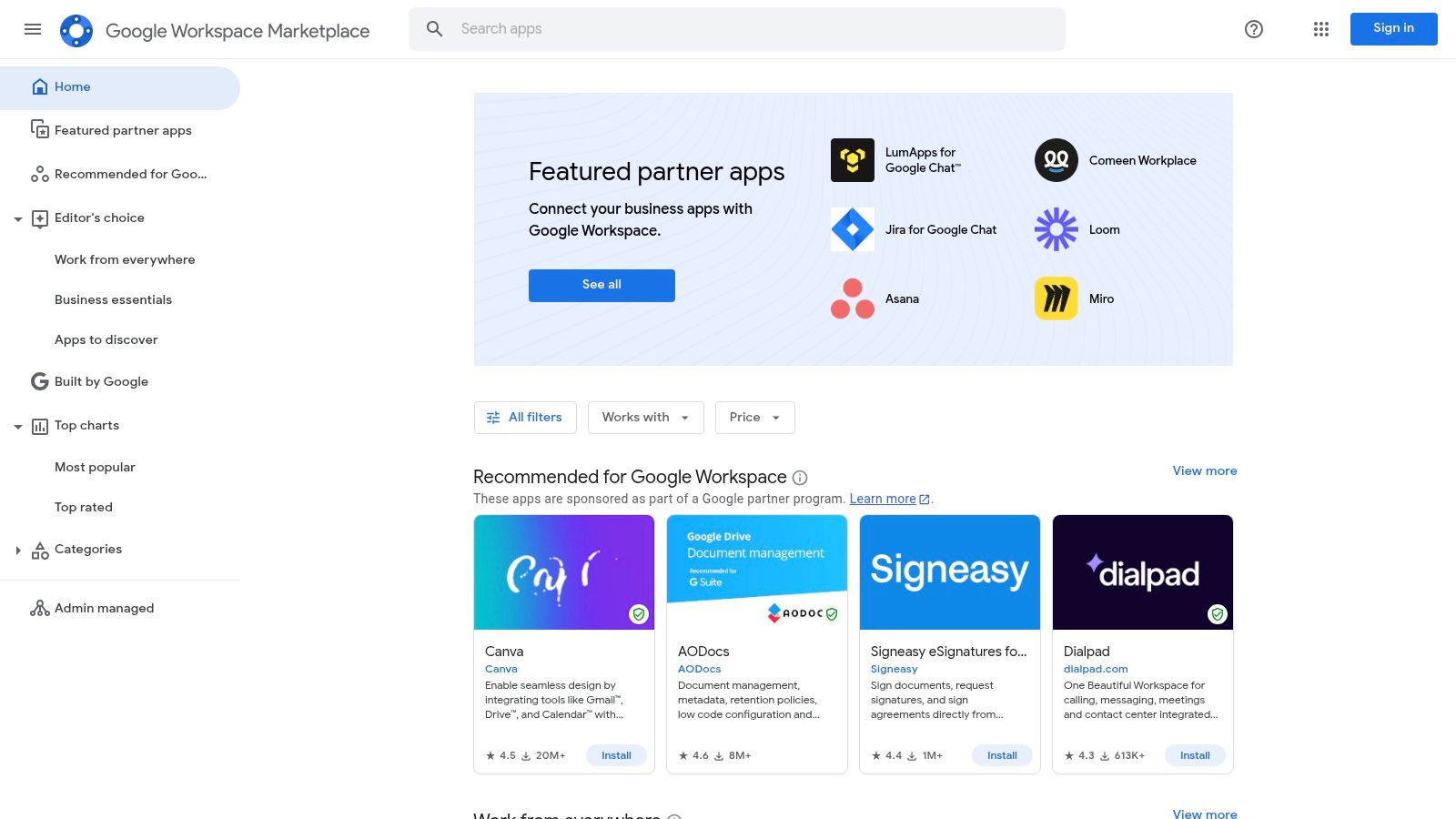
This approach makes it one of the best AI tools for marketers focused on workflow efficiency, as it eliminates the need to constantly switch between applications for content creation, research, or automation. For businesses, the ability for administrators to manage and deploy these tools securely across the entire domain provides essential governance.
Key Features & Use Cases
- Integrated AI Add-ons: Install tools that perform tasks like generating blog posts in Docs, analyzing customer feedback in Sheets, or drafting personalized email campaigns in Gmail.
- Gemini “Gems” Integration: Access custom-built chatbots directly within the side panels of Workspace apps for on-demand research, summarization, and brainstorming without leaving your document.
- Admin-Managed Deployment: IT administrators can vet, approve, and deploy specific AI add-ons domain-wide, ensuring security compliance and uniform tool access for the whole team.
Pricing and Access
Access to the Marketplace is free. Individual add-ons have their own pricing models, ranging from free tiers to premium subscriptions, which are often managed with the third-party vendor directly.
Pros and Cons
| Pros | Cons |
|---|---|
| Keeps workflows in familiar apps: Boosts productivity by embedding AI into existing Docs, Sheets, and Gmail routines. | Variable App Quality: The quality and support for third-party add-ons can be inconsistent. |
| Supports governance and security: Admin controls allow for safe, scalable deployment across an organization. | Complex Billing: Some add-ons require separate billing and subscriptions outside of Google's system. |
Website: https://workspace.google.com/marketplace
10. OpenAI GPT Store (ChatGPT GPTs)
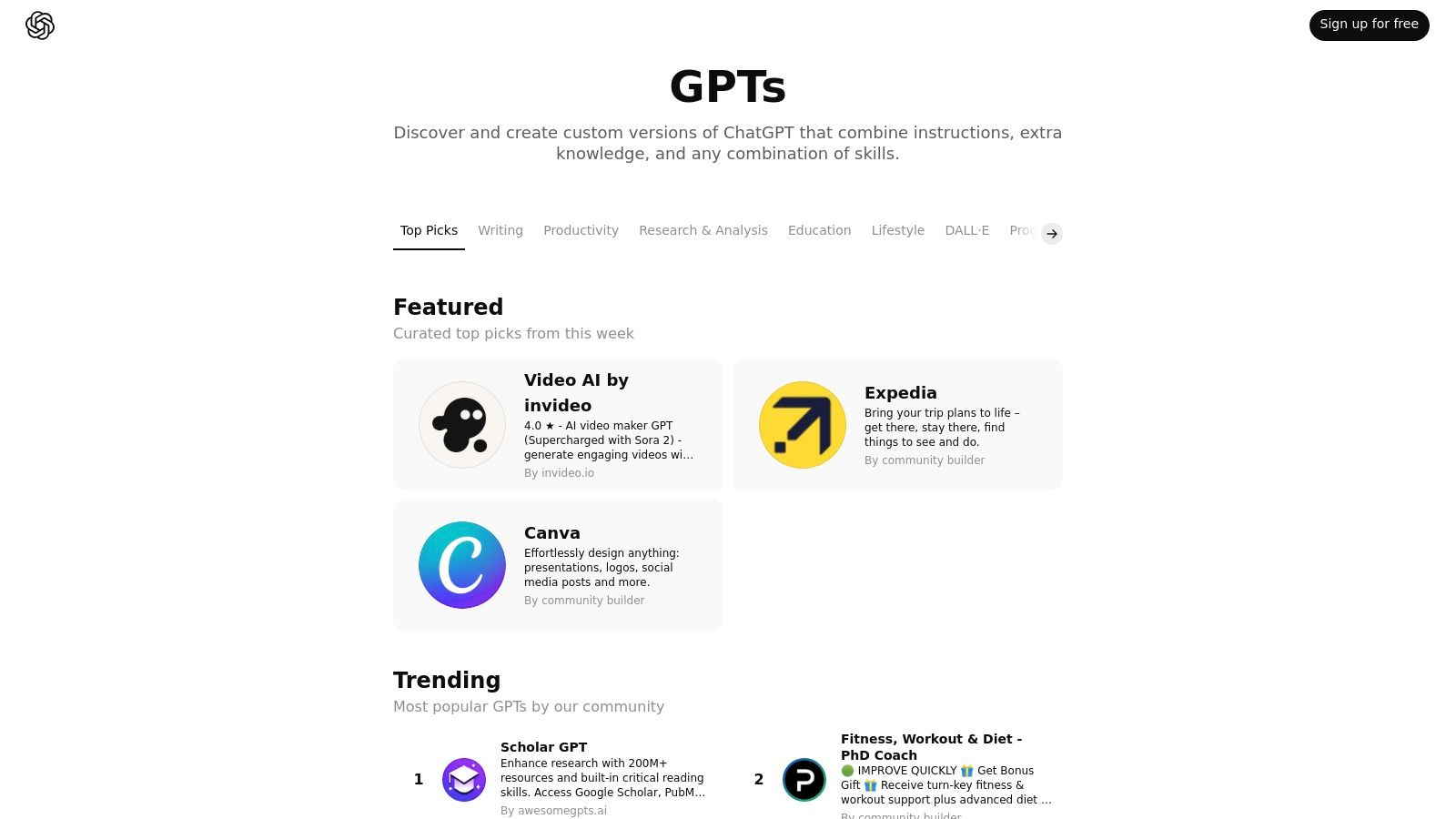
Instead of a single tool, the OpenAI GPT Store offers a powerful catalog of thousands of specialized AI assistants built on ChatGPT. For marketers, this is like having an on-demand team of specialists. You can find, use, or adapt custom GPTs for hyper-specific tasks like writing ad copy in the AIDA framework, generating SEO keyword clusters, or creating social media content calendars. This makes it one of the most versatile and best AI tools for marketers looking to rapidly deploy tailored solutions without any coding.
The store's real value lies in its specificity. Rather than using a general model, you can select a GPT trained with custom instructions and knowledge for a niche marketing function, such as drafting press releases or analyzing customer feedback for sentiment. This approach saves significant time on prompt engineering and delivers more consistent, high-quality outputs.
Key Features & Use Cases
- Specialized GPT Catalog: Browse a vast library of public GPTs for marketing, including persona generators, ad copy creators, and competitive analysis bots.
- Custom GPT Builder: Create your own private GPTs tailored to your brand’s voice, workflows, and proprietary data without writing a single line of code. Learn more about how GPTs fit into the landscape of AI content creation tools.
- Team & Enterprise Governance: Deploy and manage custom GPTs securely within your organization, ensuring brand consistency and data privacy. For more discussions on its applications, you can explore articles tagged with ChatGPT.
Pricing and Access
Access to the GPT Store and the ability to use most custom GPTs requires a ChatGPT Plus, Team, or Enterprise subscription, which starts at $20/month per user.
Pros and Cons
| Pros | Cons |
|---|---|
| Rapid Deployment: Instantly "hire" a specialized AI assistant for any marketing task. | Requires Paid Plan: Full access is gated behind a ChatGPT subscription. |
| Easy Customization: Effortlessly adapt or build GPTs to match your brand's unique voice. | Variable Quality: The performance and quality of public GPTs can be inconsistent. |
Website: https://chatgpt.com/gpts
11. Semrush App Center
For marketing teams already invested in the Semrush ecosystem, the Semrush App Center is a powerful gateway to extending its capabilities with specialized AI. Rather than being a standalone tool, it’s an in-product marketplace offering a curated selection of third-party, AI-powered applications that integrate directly into your existing SEO, content, and social media workflows. This makes it an excellent choice for centralizing your toolkit without leaving the platform you already use.
The primary advantage is seamless integration. These apps are designed to augment core Semrush functions, allowing you to deploy AI for tasks like content generation, social media management, and even advanced AI-search visibility monitoring. This turns Semrush from a powerful analytics platform into a comprehensive command center for a wide range of marketing activities, solidifying its place among the best AI tools for marketers who prioritize workflow efficiency. Learn more about the Semrush App Center on promptden.com.
Key Features & Use Cases
- Integrated AI Content Assistants: Access AI writing tools that pull data directly from your Semrush projects to generate SEO-optimized content briefs, articles, and copy.
- AI Social Media Management: Utilize apps like the AI Social Assistant to automate post creation, scheduling, and analytics across multiple platforms from a single interface.
- AI-Search Visibility Tools: Plug in specialized apps designed to monitor and report on your visibility in emerging AI-driven search environments like Google SGE.
Pricing and Access
Access to the App Center requires an active Semrush subscription. Most apps are offered as paid add-ons with their own monthly or annual subscription fees, though many provide free trials.
Pros and Cons
| Pros | Cons |
|---|---|
| Centralized AI Toolkit: Purchase and manage AI add-ons directly within your Semrush account. | Requires Semrush Account: The platform is inaccessible without a base Semrush subscription. |
| Workflow Focused: Apps are specifically built for marketer tasks like SEO, content, and social. | Add-On Costs: Many valuable apps are additional subscriptions, increasing the total cost. |
Website: https://www.semrush.com/app-center
12. Zapier
Zapier is the central nervous system for a modern marketing team, acting as an AI orchestration platform that connects and automates the entire marketing stack. It enables marketers to build powerful, no-code AI workflows, agents, and chatbots that bridge the gap between thousands of different applications. This makes it one of the best AI tools for marketers looking to operationalize AI without writing a single line of code.

Its core strength is its vast integration library, connecting to over 7,000 apps from CRMs to ad platforms. The addition of "AI by Zapier" allows users to inject multi-model AI capabilities directly into these automations, turning simple triggers into intelligent, multi-step processes. For a deeper dive into similar platforms, you can learn more about AI workflow automation tools.
Key Features & Use Cases
- No-Code AI Workflows: Automatically enrich new CRM leads with AI-powered data, summarize customer feedback from surveys, and draft personalized email responses.
- Custom AI Agents & Chatbots: Build internal chatbots that can answer team questions by searching your knowledge base or create external bots to qualify leads on your website.
- Extensive App Directory: Connect virtually any tool in your marketing arsenal, including Salesforce, Google Ads, Slack, and social media platforms, to create end-to-end automations.
- Canvas & Tables: Visually map out complex automation logic with Canvas and use Zapier Tables as a lightweight database to store and manipulate data within your workflows.
Pricing and Access
Zapier offers a free forever plan with limited tasks. Paid plans scale based on the number of tasks, the frequency of automation runs, and access to premium apps and features. Enterprise plans add advanced security and governance controls.
Pros and Cons
| Pros | Cons |
|---|---|
| Rapid AI Operationalization: A fast, no-code way to connect AI to existing marketing tools. | Scaling Costs: Costs can increase significantly with high task volume and more complex automations. |
| Unmatched Integrations: Connects to a vast ecosystem of over 7,000 marketing and business apps. | Potential Complexity: Building and maintaining highly intricate workflows may require expert-level knowledge. |
Website: https://zapier.com
Top 12 AI Marketing Tool Marketplaces — Comparison
| Platform | Core focus & features | Quality (★) | Price / Value (💰) | Audience & USP (👥 ✨) |
|---|---|---|---|---|
| PromptDen 🏆 | Cross-model prompt library (ChatGPT, Gemini, Claude), image & video prompts, marketplace, PromptForge, browser extensions | ★★★★ | 💰 Mix of free community content + individually priced marketplace assets | 👥 Prompt engineers, marketers, creators — ✨ PromptForge & direct workflow injections |
| G2 | Vetted B2B reviews, category rankings, buyer guides, comparison matrices | ★★★★★ | 💰 Free browsing; vendor pricing often on vendor sites | 👥 Buyers researching enterprise tools — ✨ Verified reviews & editorial lists |
| Capterra | Buyer guides, pricing snapshots, filters for free/freemium/paid tools | ★★★★ | 💰 Price callouts where available; good budget signals | 👥 Non‑technical marketers & procurement — ✨ Clear pricing summaries |
| Product Hunt | Daily launches, product pages with comments, curated collections | ★★★★ | 💰 Mostly free discovery; product pricing varies post-launch | 👥 Early adopters, founders — ✨ Fast way to spot emerging tools |
| AppSumo | Time‑boxed deals & lifetime offers, refund windows, app pages | ★★★ | 💰 💰 Low entry cost via deals; risk of churn/term changes | 👥 Budget‑sensitive teams & solo founders — ✨ Lifetime deals & refunds |
| HubSpot App Marketplace | Native HubSpot apps & Breeze Agents, plan requirements shown | ★★★★ | 💰 Listings include plan notes; some require vendor subscriptions | 👥 HubSpot users — ✨ Native CRM/data integrations & agents |
| Shopify App Store | Store‑specific AI marketing apps, one‑click installs, merchant reviews | ★★★★ | 💰 Tiered pricing & platform billing; premium apps exist | 👥 DTC & ecommerce merchants — ✨ One‑click install + consolidated billing |
| Salesforce AppExchange | Enterprise AI marketing apps integrated with Salesforce CRM | ★★★★ | 💰 Often enterprise pricing (contact vendors) | 👥 Salesforce customers/enterprises — ✨ CRM‑grade integrations & compliance |
| Google Workspace Marketplace | AI add‑ons for Docs/Sheets/Gmail, Gemini “Gems”, admin controls | ★★★ | 💰 Free & paid add‑ons; vendor billing sometimes separate | 👥 Workspace users & IT admins — ✨ In‑app AI with domain governance |
| OpenAI GPT Store (ChatGPT GPTs) | Catalog of custom GPTs, customizable assistants, team governance | ★★★★ | 💰 Often requires ChatGPT paid plan; monetization policies evolving | 👥 Teams wanting tailored assistants — ✨ Fast deployable, customizable GPTs |
| Semrush App Center | In‑product AI apps for SEO, social, content; knowledge base | ★★★★ | 💰 Add‑on subscriptions inside Semrush; regional variation | 👥 SEO‑led marketing teams — ✨ Apps integrated into Semrush workflows |
| Zapier | AI orchestration, agents, no‑code automations across 7k+ apps | ★★★★ | 💰 Usage‑based pricing; costs scale with tasks | 👥 Ops/marketing teams & enterprises — ✨ No‑code automation + multi‑app scale |
Making Your Final Choice: How to Select the Right AI Tool
Navigating the expansive landscape of AI marketing tools can feel overwhelming, but this guide has illuminated a crucial truth: the quest isn't for a single, mythical "best" tool. Instead, the goal is to strategically assemble an AI-powered marketing stack that acts as a direct extension of your team, amplifying your strengths and automating your most significant operational drags. We've explored comprehensive review platforms like G2 and Capterra for due diligence, innovation hubs like Product Hunt for cutting-edge solutions, and ecosystem-specific marketplaces from HubSpot, Salesforce, and Semrush that guarantee seamless integration. The key takeaway is that value is derived not from a tool's feature list alone, but from its ability to harmoniously integrate into your existing workflows.
The journey to finding the best AI tools for marketers begins with a clear-eyed audit of your current processes. Rather than being dazzled by the latest generative video model or analytics engine, start by pinpointing your most persistent bottlenecks. Is your content team struggling to scale production? Are you spending too many hours manually segmenting email lists? Is your ad creative failing to resonate? Answering these questions first will transform your search from a speculative exploration into a targeted, problem-solving mission.
A Practical Framework for Your Selection Process
To make your decision-making process more concrete, consider a tiered approach. First, map out your core marketing functions: SEO, content creation, social media management, advertising, and analytics. Then, for each function, identify the primary challenge you need to solve. This focused approach allows you to evaluate tools based on their direct impact on your most critical KPIs.
Here is a simple framework to guide your selection:
- Identify the Core Problem: Start with a clear problem statement. For example, "We need to increase organic traffic, but our keyword research and content briefing process is too slow and manual."
- Consult Broad Marketplaces: Use platforms like G2 and Capterra to create a shortlist of top-rated tools that address your specific problem. Pay close attention to recent reviews from companies of a similar size and industry.
- Explore Integrated Solutions: Check your existing CRM or marketing platform's app marketplace (e.g., HubSpot App Marketplace, Salesforce AppExchange). A tool that natively integrates with your central source of truth will always deliver a higher ROI by reducing data silos and manual data entry.
- Test for Workflow Compatibility: Take advantage of free trials. The most important test is not "Can this tool do X?" but "How easily can my team incorporate this tool into their daily routine?" A powerful but clunky tool will quickly become shelf-ware.
- Prioritize Automation and Connectivity: Consider how a new tool will connect with your other systems. Platforms like Zapier are invaluable for stitching together disparate applications, creating automated workflows that save hundreds of hours in the long run.
Beyond the Tool: Implementation and Adoption
Remember, purchasing a subscription is only the first step. True transformation comes from successful implementation and team-wide adoption. Designate an internal "AI champion" who can lead the onboarding process, document best practices, and build a shared repository of effective workflows and prompts. Fostering a culture of experimentation is critical; encourage your team to test, learn, and share their findings. The most successful marketing teams will be those who not only adopt AI but also master the art of communicating with it effectively. This is where mastering prompt engineering becomes a non-negotiable skill.
Ultimately, the goal is to build a synergistic ecosystem where each tool communicates with the others, creating a cohesive engine that drives efficiency, creativity, and measurable growth. By moving beyond the search for a single perfect platform and focusing instead on building a smart, integrated stack, you are not just adopting technology. You are fundamentally redesigning the future of your marketing department.
Ready to master the language of AI and unlock the full potential of your new tools? The quality of your AI output is directly tied to the quality of your input. PromptDen is a collaborative platform where you can discover, test, and share high-performance prompts specifically designed for marketing tasks like SEO, content creation, and ad copy. Elevate your strategy by starting with proven prompts from a community of experts. Explore the PromptDen library today and start generating better marketing results instantly.