
8 Powerful Character Design Prompts for AI Artists in 2025
Staring at a blank page or an empty AI prompt bar can be daunting. The right spark, the perfect character design prompt, can transform that void into a universe of possibility. Whether you're a seasoned concept artist using Midjourney, a storyteller plotting your next narrative, or an AI enthusiast exploring creative generation, the foundation of every great story is a compelling character.
This article moves beyond generic advice, offering eight structured, powerful character design prompts ready for creative exploration and AI implementation. Each prompt is a complete framework designed to build depth, motivation, and visual identity from the ground up, helping you craft characters that are not just visually stunning but also narratively resonant. To truly master character design, understanding how to generate ideas efficiently and creatively is paramount, and these prompts serve as the perfect catalyst.
We will explore established frameworks like the Hero's Journey and subversive techniques like flaw-centered design to ensure your next creation is your most memorable yet. By the end, you will have a versatile toolkit of actionable prompts to break through creative blocks and bring unforgettable characters to life, complete with practical examples for immediate use.
1. The Hero's Journey Character
Rooted in Joseph Campbell's monomyth, this prompt framework guides the creation of a character destined for a transformative adventure. The Hero's Journey is a narrative pattern involving departure from the known, a series of trials in an unknown world, and an eventual return, fundamentally changed. This structure provides a powerful and universally resonant foundation for compelling character design prompts.

When crafting your character, think of them as the protagonist in a grand story, much like Luke Skywalker or Katniss Everdeen. Their design should reflect their initial state, the challenges they will face, and the hero they are destined to become. This approach is ideal for developing main characters for video games, epic sagas, or any story centered on personal growth and overcoming adversity.
Actionable Tips for Implementation
- Define the Call to Adventure: What event disrupts your character's ordinary world? Your prompt should specify this catalyst. For example:
A young desert scavenger who discovers a hidden message inside a droid, setting them on an unexpected quest. - Identify Mentors and Guardians: Every hero needs guidance. Incorporate a mentor figure or a "threshold guardian" who tests their resolve. Example:
Character design of a wise, exiled master teaching the reluctant hero to control their latent powers. - Visualize the Transformation: The core of the journey is change. Ensure your prompt allows for visual evolution. Use contrasting descriptions like "from timid farmhand to battle-hardened warrior" to guide the AI in showing this progression.
- Balance Archetype with Uniqueness: While the hero is an archetype, add specific, unique personality traits to avoid clichés. Maybe your hero is cynical, overly cautious, or has an unusual hobby.
This method excels at producing characters with a clear narrative purpose and a strong emotional arc. For a deeper exploration of prompts built on this structure, you can explore various takes on The Hero's Journey Character.
2. Archetype-Based Character Design
Rooted in the psychological theories of Carl Jung, this framework uses universal, instinctual patterns of personality and behavior to build characters. Archetypes like the Sage, the Rebel, or the Jester are symbolic figures that exist in the collective unconscious, making them instantly recognizable and relatable to audiences worldwide. This approach provides a solid foundation for character design prompts by tapping into deep-seated human understanding.
When crafting your character, think about the core role they play in the narrative, much like Dumbledore as the Mentor or Loki as the Trickster. Their design should visually communicate their archetypal function, from their clothing and posture to their key accessories. This method is exceptionally effective for creating a balanced cast of characters where each member serves a distinct and understandable purpose within the story.
Actionable Tips for Implementation
- Define the Core Archetype: Select a primary archetype to form the character's foundation. Your prompt should clearly state this role. For example:
Character concept for a cynical, world-weary detective embodying the Ruler archetype, obsessed with imposing order on a chaotic city. - Blend Archetypes for Complexity: Pure archetypes can feel one-dimensional. Combine two or more to add depth. Example:
Design an Explorer-Magician, a character driven by a thirst for discovering ancient, forbidden knowledge, whose appearance blends rugged adventuring gear with mystical artifacts. - Subvert Expectations: Start with a familiar archetype and add a surprising twist. This creates intrigue and originality. For instance, you could prompt:
A Jester archetype who is secretly the story's main antagonist, using humor and chaos to mask their sinister plans. - Visualize the Archetype's Symbols: Each archetype has associated symbols and aesthetics. Use them in your prompt to guide the AI's visual output. Prompting for
a Sage surrounded by ancient scrolls and celestial mapsimmediately communicates wisdom and knowledge.
This technique is powerful for creating characters that resonate on a subconscious level, ensuring their roles and motivations are intuitively grasped by the audience. For a more in-depth look at Jungian psychology in storytelling, consider resources that explore these foundational concepts.
3. Reverse Character Traits Prompt
This creative exercise challenges designers to take conventional character traits and invert them, creating unexpected and complex personalities. The Reverse Character Traits prompt subverts audience expectations by building a character who appears one way on the surface but possesses a contradictory, often hidden, inner nature. This method is a powerful tool for developing fresh, memorable designs that defy simple categorization.
When using this approach, think of characters like Walter White, who transforms from a mild-mannered teacher into a ruthless kingpin, or Deadpool, a wisecracking anti-hero who operates with a surprisingly strong moral compass. The core idea is to create a compelling internal conflict that manifests visually. This technique is perfect for crafting morally gray protagonists, unpredictable villains, and any character whose design needs to hint at a deeper, hidden complexity.
Actionable Tips for Implementation
- Establish and Invert the Archetype: Begin with a familiar character type and then flip its core trait. Your prompt should clearly define both sides. For example:
A stoic, intimidating royal guard who secretly writes whimsical poetry and loves cute animals. - Motivate the Contradiction: The reversal shouldn't be random; it needs a believable origin. Incorporate a backstory element that explains the conflicting traits. Example:
Character design of a cheerful, bubbly jester who is secretly a master spy, forced into their role to protect their family. - Visualize the Internal Conflict: The character's design should reflect their duality. Use visual cues that clash or hint at their hidden nature, like a stern warrior with a single, brightly colored accessory.
- Balance Subversion with Believability: While the goal is to surprise, the character must still feel cohesive. Ensure the inverted trait logically coexists with their primary persona, even if it creates tension.
This method excels at generating character design prompts that produce layered, thought-provoking figures with significant narrative potential. It forces the AI to move beyond stereotypes and explore the rich territory of human contradiction.
4. Occupation-Based Character Development
This prompt framework centers on a character's profession, using the authentic details of a specific job to build their personality, skills, worldview, and appearance. By grounding a character in a real-world (or fantasy-world) career, their design gains immediate depth and a natural source of conflict, making them more believable and relatable. This approach uses a job not just as a label, but as the core pillar of the character's identity.
When designing your character, consider how their profession shapes every aspect of their being, much like the diagnostic brilliance of Dr. Gregory House or the unwavering competence of Ellen Ripley. Their clothing, tools, posture, and even their vocabulary are all informed by their daily work. This method is perfect for creating grounded characters for procedural dramas, workplace comedies, or any story where expertise plays a crucial role.
Actionable Tips for Implementation
- Integrate Occupational Tools and Attire: A character's job dictates their gear. Specify these details in your prompt to create an authentic visual. For example:
A grizzled deep-sea welder, their face illuminated by the arc of their torch, wearing a heavily modified atmospheric diving suit covered in barnacles and company logos. - Let the Job Define Their Worldview: A profession shapes how someone sees the world. A detective sees clues, a botanist sees ecosystems. Use this perspective in your prompt. Example:
Character design of an urban architect who sees the city not as buildings, but as a living organism with its own circulatory and nervous systems. - Introduce Professional Conflict: Every job has inherent challenges and rivalries. Use these as a source for dynamic character design prompts. For instance:
A meticulous, old-school watchmaker forced to compete with a brash young rival who uses AI and 3D printing. - Balance Professional and Personal Life: Show how the demands of the job spill into their personal life, or vice-versa. This contrast creates a more well-rounded character. A prompt could be:
A cheerful kindergarten teacher who moonlights as a stoic, no-nonsense bouncer at a nightclub.
Using an occupation as a foundation excels at producing characters who feel authentic and possess a clear function within their world. The inherent details of a job provide a rich palette for visual and narrative development.
5. Personality Type System Character Prompt
Grounded in established psychological frameworks, this prompt method uses systems like the Myers-Briggs Type Indicator (MBTI), Enneagram, or the Big Five personality traits to build characters with deep, consistent, and believable psychologies. These systems offer a structured shorthand for complex human behaviors, motivations, and fears, providing a solid foundation for crafting intricate and compelling character design prompts.
When creating your character, think of them as a living embodiment of a specific psychological profile, such as an "INTJ Architect" or an "Enneagram Type 4 Individualist." Their design, from posture and expression to clothing and environment, should reflect their core personality. This approach is excellent for developing characters in dramas, role-playing games, or any narrative where internal conflict and interpersonal dynamics are central to the story.
Actionable Tips for Implementation
- Choose a Framework and Define the Core Type: Select a system and assign a type to your character. Your prompt should clearly state this. For example:
Character design of an ENFP "Campaigner," whose vibrant and chaotic art studio reflects their passionate and creative nature. - Translate Traits into Visuals: Connect abstract personality traits to concrete visual elements. An organized "Type 1 Perfectionist" might have neat clothing and a severe haircut, while a spontaneous "Type 7 Enthusiast" could have eclectic, brightly colored accessories.
- Show Strengths and Flaws: Every personality type has inherent strengths and weaknesses. Ensure your prompt includes this duality. Example:
Design an Enneagram Type 8 "Challenger" as a powerful CEO, whose commanding presence is undermined by a subtle, defensive posture that hints at their fear of being controlled. - Create Conflict and Growth: Use the framework to create internal or external conflict. A character's journey might involve overcoming the limitations of their type or integrating a healthier version of it. Prompt for a visual representation of this change, such as "from a reclusive INTP to a confident leader."
This method excels at generating characters who feel psychologically real and consistent, allowing for nuanced storytelling. For a more comprehensive look at prompts based on these frameworks, you can explore a wide variety of Personality Type System Character Prompts.
6. Visual-First Character Design Prompt
This approach prioritizes aesthetics, silhouette, and color psychology as the starting point for character creation. Instead of beginning with a backstory or personality, the Visual-First prompt uses appearance as the primary driver, allowing the character's narrative and traits to emerge from their design. This method asserts that a character's look is a powerful storytelling tool in itself, capable of communicating their essence without a single word.
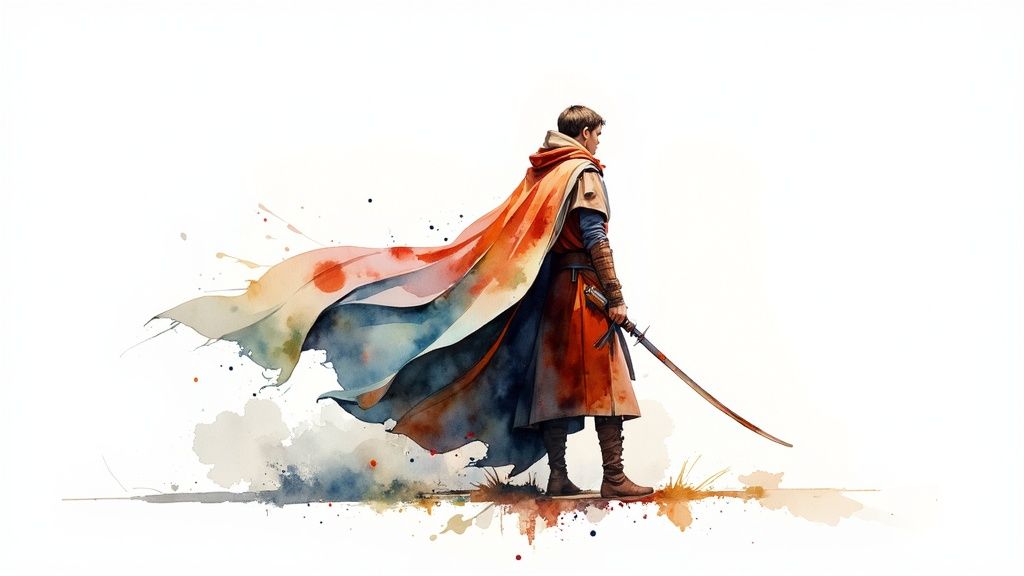
Think of iconic designs like the Joker, whose chaotic appearance immediately conveys his nature, or the distinct silhouettes of Disney princesses that make them instantly recognizable. This method is perfect for projects where visual impact is paramount, such as in animation, concept art for games, and graphic novels. It ensures the character is memorable and communicates their role effectively to the audience from the first glance.
Actionable Tips for Implementation
- Start with a Strong Silhouette: A character's outline should be unique and readable. Your prompt should focus on this core shape. Example:
Character design of a stoic knight with a triangular silhouette, defined by massive pauldrons and a tapering greatsword. - Leverage Color Psychology: Use color to evoke emotion and define personality. Be intentional with your palette choices. For example:
A mischievous forest spirit designed with a palette of vibrant, almost toxic greens and purples to suggest a playful but dangerous nature. - Design a Story-Rich Costume: The character's attire should reflect their background, profession, and culture. Ensure your prompt includes details about their clothing. Example:
An elderly desert nomad whose layered, sand-worn robes are patched with fabrics from a dozen different cultures. - Prioritize Readability: The design should be clear and understandable even at a distance or as a small icon. Use bold, simple shapes and a limited color palette to achieve this.
This technique is excellent for generating visually striking character design prompts that serve as a strong foundation for further narrative development. To create stunning AI-generated images with this method, you can learn more about Midjourney image generation techniques.
7. Backstory-Driven Character Prompt
This approach prioritizes a character's history, using a detailed backstory to inform every aspect of their design, personality, and motivation. Instead of starting with a visual concept, you begin by crafting a comprehensive life story. This method ensures that a character's actions, fears, and goals are deeply rooted in believable experiences, making them feel more authentic and three-dimensional.
Think of characters like Walter White, whose transformation from a mild-mannered teacher to a ruthless kingpin is driven entirely by a history of missed opportunities and personal failures. Their past isn't just trivia; it's the engine of their entire narrative. This type of prompt is perfect for creating psychologically complex characters for dramas, role-playing games, or any story where internal conflict is a central theme.
Actionable Tips for Implementation
- Identify Formative Events: Pinpoint 3-5 key moments that defined your character. Your prompt should incorporate these events. For example:
A former royal guard, now a cynical mercenary, haunted by the memory of failing to protect the royal family during a coup. - Connect Past Trauma to Present Behavior: Show, don't just tell, how their history affects them now. Use the backstory to justify their flaws, fears, or strengths. Example:
Character design of a brilliant but paranoid inventor who trusts no one after their revolutionary work was stolen by a former mentor. - Use History to Define Goals: A character's desires are often shaped by what they've lost or what they've never had. Frame your prompt around this connection. For instance:
An orphan who grew up on the streets, now obsessed with building a powerful syndicate to create the family and security they never had. - Incorporate Physical Manifestations: Let the backstory influence their physical appearance. Scars, tattoos, or a specific style of clothing can all tell a story. Prompt idea:
A veteran soldier with a prosthetic arm and visible burn scars from a battle that changed the course of their life.
Using a backstory-driven method is one of the most effective character design prompts for generating individuals with realistic motivations and a powerful sense of presence. It grounds your creation in a tangible history, making their journey more impactful.
8. Flaw-Centered Character Design Prompt
This character development approach starts by identifying a core flaw, weakness, or limitation that drives the character's decisions and conflicts. Instead of adding imperfections as an afterthought, this method makes them the central pillar of the character's identity, ensuring a more human and relatable design. This framework creates deeply compelling and psychologically rich character design prompts.
When creating your character, think of their central flaw as the engine of their story, much like Tony Stark's narcissism or Hamlet's indecision. Their visual design, choices, and relationships should all stem from or be influenced by this defining imperfection. This approach is perfect for crafting tragic heroes, complex anti-heroes, or any character whose story revolves around internal conflict and personal struggle.
Actionable Tips for Implementation
- Define the Core Flaw: Your prompt should explicitly state the character's primary weakness. This flaw should create tangible story complications. For example:
A brilliant but pathologically proud inventor who refuses to accept help, even as their creations spiral out of control. - Ground the Flaw in Backstory: A flaw is more believable when it has an origin. Connect it to a past event or their upbringing. Example:
Character design of a knight whose crippling cowardice stems from a traumatic childhood battle. - Visualize the Consequences: The character's design and environment should reflect the consequences of their flaw. A hoarder's room would be cluttered; an arrogant noble might wear ostentatious, impractical clothing.
- Determine the Arc: Decide if the character's journey is about overcoming their flaw (a growth arc) or succumbing to it (a tragic arc). Your prompt can specify this. Use phrases like "struggling to overcome their greed" or "consumed by their thirst for revenge" to guide the AI.
This method excels at generating characters with built-in conflict and a clear potential for a dramatic narrative. By leading with a flaw, you guarantee a character who is not just a collection of traits but a dynamic individual facing a genuine internal battle.
8-Point Character Prompt Comparison
| Prompt / Approach | Implementation Complexity 🔄 | Resource Requirements ⚡ | Expected Outcomes ⭐📊 | Ideal Use Cases 📊 | Key Advantages ⭐ |
|---|---|---|---|---|---|
| The Hero's Journey Character | Moderate — multi-stage arc to map 🔄 | Moderate — planning, narrative mapping ⚡ | Strong emotional arc and clear transformation ⭐📊 | Epic/genre narratives, hero-focused stories 📊 | Universal resonance; clear storytelling direction ⭐ |
| Archetype-Based Character Design | Low–Moderate — template-driven but needs nuance 🔄 | Low — reference materials; modest research ⚡ | Immediate recognizability; clear role function ⭐📊 | Ensemble casts, mythic or symbolic stories 📊 | Fast clarity for audiences; easy to subvert for depth ⭐ |
| Reverse Character Traits Prompt | Moderate — requires justification for inversions 🔄 | Moderate — backstory and careful writing ⚡ | High originality; surprising, complex characters ⭐📊 | Antiheroes, twists, morally ambiguous dramas 📊 | Produces memorable, unpredictable characters ⭐ |
| Occupation-Based Character Development | Moderate — research-heavy but systematic 🔄 | High — subject-matter research, consultants ⚡ | Authenticity and believable skillsets; plot hooks ⭐📊 | Procedurals, workplace drama, realistic fiction 📊 | Grounds character in real-world detail; credible conflict ⭐ |
| Personality Type System Character Prompt | Low — structured by model definitions 🔄 | Low — familiarity with systems (MBTI/Enneagram) ⚡ | Consistent behavior patterns and relational maps ⭐📊 | Ensemble dynamics, character consistency across beats 📊 | Psychological coherence and easy analysis language ⭐ |
| Visual-First Character Design Prompt | Low–Moderate — visual concepts precede psychology 🔄 | High — design skills, art assets, tools ⚡ | Immediate visual recognition and brandability ⭐📊 | Animation, games, concept art, merchandising 📊 | Strong silhouette and marketable identity ⭐ |
| Backstory-Driven Character Prompt | High — deep documentation and causal mapping 🔄 | High — extensive writing time and exercises ⚡ | Deeply motivated, believable characters; rich material ⭐📊 | Character studies, long-form narratives, dramas 📊 | Rich motivation source; fuels dialogue and arcs ⭐ |
| Flaw-Centered Character Design Prompt | Moderate — focus on believable flaw impact 🔄 | Moderate — psychology, testing, iteration ⚡ | Relatable conflict and clear arc potential ⭐📊 | Tragedy, redemption arcs, character-driven drama 📊 | Generates empathy and narrative tension; avoids perfectionism ⭐ |
From Prompt to Persona: Your Next Steps
The character design prompts we've explored offer more than just a starting point; they are foundational frameworks for breathing life into your ideas. From the narrative arc of the Hero's Journey to the psychological depth of Archetype-Based design and the subversive twist of the Reverse Traits method, each approach provides a unique lens for building compelling personas. You now have a strategic toolkit to move beyond generic concepts and create characters with authentic motivations, memorable flaws, and a distinct visual presence.
The true power of these techniques is unlocked when you start combining them. Think of it as a creative alchemy. You can begin with a strong visual silhouette from a Visual-First prompt, then layer in a core weakness discovered through the Flaw-Centered approach. Take a classic Occupation-Based character, like a grizzled detective, but assign them an unexpected personality type, such as an INFP, to create immediate tension and depth.
Putting These Prompts into Practice
As you experiment, remember that these are not rigid formulas but flexible guides. The most iconic characters are rarely born from a single idea. They are a complex synthesis of multiple concepts, refined over time. Here are some actionable next steps to integrate these powerful character design prompts into your workflow:
- The Mix-and-Match Method: Choose two different frameworks from this article and merge them. For example, create a Backstory-Driven character who also embodies a specific reversed archetype. Document how the two frameworks influence and shape each other.
- Iterate and Refine: Generate three versions of the same core character using three different prompt structures. One might be flaw-centered, another occupation-based. This exercise will reveal new dimensions and help you select the strongest elements from each iteration.
- Build a Character Bible: Once you land on a concept you love, start a simple document or "character bible." Use the prompts as section headers (Backstory, Core Flaw, Visuals) to flesh out the details. This becomes an invaluable reference for any future project.
From Static Image to Dynamic Story
Mastering the art of the prompt is the first critical step. Once you've crafted your character's persona, backstory, and visual look, the next frontier is bringing them to life. This is where modern technology can act as a powerful creative partner. By using AI character animation tools, you can transform your static designs into dynamic, moving creations, perfect for storytelling, marketing, or prototyping. This transition from concept to animated reality is more accessible than ever, allowing you to test how your character moves, expresses emotion, and interacts with their world.
Ultimately, a great character connects with an audience on an emotional level. They feel real, relatable, and unforgettable. The frameworks and prompts outlined here are your tools to build that connection. They provide the structure needed to ensure your creations are not just visually interesting, but psychologically resonant. So take these ideas, twist them, break them, and build something entirely new. Your next great character is just a prompt away.
Ready to find your next great idea or share your own creative sparks? Explore thousands of community-curated prompts on PromptDen. It's the ultimate marketplace to discover, sell, and buy high-quality character design prompts and turn your inspiration into a valuable asset. Find your next masterpiece at PromptDen.