
Generate Long Tail Keywords That Convert

To really win at SEO, you have to start thinking small. I know, it sounds counterintuitive. Everyone wants to rank for those big, flashy keywords. But the real conversions? They’re hiding in plain sight, tucked away in specific, multi-word phrases that reveal exactly what a searcher wants.
Think less "mattress" and more "best memory foam mattress for side sleepers with back pain." Shifting your focus here is about attracting fewer people, but the right people—the ones who are actually ready to pull out their credit cards.
The Hidden Value in High-Intent Searches

It’s easy to get caught up chasing massive search volume. Those broad "head terms" look great on a report, but they mostly bring in an audience that’s just kicking the tires. They're browsing, not buying. The real magic happens when you dial in on long-tail keywords.
These longer, more descriptive phrases are a direct pipeline to users who know precisely what they’re looking for. That specificity signals a much stronger intent to purchase, and that’s why they convert at a significantly higher rate. It’s not about getting all the traffic; it's about getting the traffic that matters.
Understanding the Intent Gap
To see this in action, just put yourself in the shoes of two different searchers.
One person types "running shoes" into Google. What do they want? They could be looking for pictures, brand histories, or just seeing what’s out there. Their intent is fuzzy and mostly informational.
Now, another person searches for "lightweight trail running shoes for wide feet." This isn’t a casual browse. They have a specific problem and are actively hunting for a solution. If your content directly answers that query, you’re not just another search result—you’re the solution they’ve been looking for.
This is the entire game when it comes to long-tail keywords. You get to connect with people at the most critical moment of their buying journey.
"Targeting long-tail keywords is a fundamental shift from a volume-first to an intent-first SEO strategy. You're not just answering a query; you're solving a specific problem for a user who is much closer to making a decision."
Short Tail vs Long Tail Keywords At a Glance
The difference between these two keyword types is stark. One casts a wide, generic net, while the other is like a laser beam, targeting users who are deep in the buying cycle.
Here's a quick breakdown to make the distinction crystal clear:
| Attribute | Short Tail Keywords (e.g., 'CRM software') | Long Tail Keywords (e.g., 'CRM software for small real estate teams') |
|---|---|---|
| Search Volume | Very High | Very Low |
| Competition | Extremely High | Low |
| User Intent | Broad, often informational | Specific, often transactional |
| Conversion Potential | Low | Very High |
| Length | 1-2 words | 3+ words |
As you can see, long-tail keywords might not have the vanity metrics of their shorter counterparts, but they more than make up for it in conversion potential and reduced competition. This is where you can carve out a real competitive advantage.
The Sheer Scale of Specific Searches
While any single long-tail keyword has a tiny search volume, their combined power is absolutely massive. In fact, research shows that long-tail keywords make up over 70% of all search queries on the internet. That's not a typo.
Digging into the data from millions of keywords, you’ll find that over 80% of search queries are typed in fewer than 10 times a month. You can dive deeper into the distribution of these keyword findings and see just how diverse user searches really are.
This tells us that the vast majority of search traffic is scattered across millions of unique, highly specific phrases. By learning how to generate and target these long-tail keywords, you tap into a huge, less competitive ocean of searchers that your competition is probably ignoring completely.
2. Find Keyword Goldmines Hiding in Plain Sight
While SEO tools are great, the best long-tail keyword ideas often come straight from the source: your customers. These are the authentic, problem-focused phrases hiding right under your nose, just waiting to be found where people naturally talk about their needs.
If you shift your focus from software to people, you'll uncover keywords your competitors have completely missed.

Online communities are absolute goldmines for this stuff. People don't use "marketing speak" on platforms like Reddit, Quora, or niche industry forums; they use the exact language you should be targeting. It's raw, unfiltered, and incredibly valuable.
They describe their problems, ask hyper-specific questions, and debate solutions in their own words.
Mine Online Communities for Raw Insights
First, figure out where your people hang out. If you sell project management software, you might poke around r/projectmanagement or r/sysadmin. Look for thread titles that start with phrases like "how do I," "best way to," or "any tool for." Simple.
These threads are brimming with opportunities. A post titled "How do I manage deadlines for a remote design team?" isn't just a question—it's a perfect long-tail keyword. The comments will likely have dozens of related phrases and follow-up questions, giving you a rich list of content ideas to work with.
This screenshot from Reddit is a perfect example. A user is asking a super-detailed question about a specific software challenge. The comments reveal related frustrations and alternative solutions, all phrased in natural language. It's an ideal source for generating long-tail keywords.
Pro Tip: Don't just copy the question. Dig into the comments. Pay close attention to the specific vocabulary, the analogies they use, and the pain points they mention. This is the language that will actually resonate with your audience and tell Google your content is the perfect match.
If you want to go even deeper on finding these high-value, specific phrases, check out our guide on Mastering Long Tail Keyword Research for SEO.
Listen to Your Own Front Lines
Sometimes the best intel is right inside your own company. The people talking to customers every single day have a direct line to their most urgent problems.
- Customer Support Tickets: Go comb through support chats and emails. What problems keep popping up? Phrases like "can't figure out how to integrate with calendar" or "trouble exporting reports to PDF" are high-intent keywords that can inspire targeted tutorials or FAQ pages.
- Sales Team Conversations: Your sales team knows exactly what makes a prospect hesitate and what features get them excited. Ask them about the most common questions they hear on calls. These are often bottom-of-the-funnel queries you can build amazing content around.
- Customer Reviews: Don't just read your own reviews—read your competitors' too. The negative ones are especially useful because they highlight specific pain points and missing features that people are actively looking for solutions to.
When you tap into these real-world conversations, you stop guessing what people might search for. You get direct access to the exact words they use when they need help, which is the fastest way to get their attention and earn their business.
Uncovering Keywords with Free SEO Tools
You don't need a massive budget to find long-tail keywords that pull in the right kind of traffic. In fact, some of the most powerful sources are totally free and baked right into the search engines you already use every day. If you just pay a little closer attention, you can get a direct line into what your audience is thinking.
The easiest method starts with a simple Google search. When you start typing a broad "head term" like "content marketing strategy," you'll see Google's Autocomplete feature kick in immediately, offering up predictions based on what people are actually searching for. This isn't just a convenience; it's a goldmine.
Just look at the suggestions that pop up—phrases like "content marketing strategy for small business" or "content marketing strategy example pdf." These aren't random guesses. They're a direct reflection of what users need, giving you a quick list of high-intent keyword ideas right off the bat.
Digging into SERP Features
Once you actually hit enter, the search engine results page (SERP) itself becomes your next tool. Your eyes should immediately scan for the "People Also Ask" (PAA) box. This feature is a dynamic list of questions directly related to your search, and every single one is a valuable long-tail keyword you can build content around.
The real magic happens when you click on one of the questions. It almost always expands to reveal even more related queries, letting you spiderweb out and uncover an entire network of topics. For example, a search for "AI prompts for marketing" could easily lead you to PAA questions like:
- How do I write a good marketing prompt?
- What is the best prompt for social media posts?
- Can ChatGPT create a marketing campaign?
Each question represents a specific problem your audience is trying to solve. You can see great examples of this in action by checking out the best sources for ChatGPT prompts for marketing to see how they directly answer these kinds of user questions. Don't forget to scroll all the way to the bottom of the page, either—the "Related Searches" section offers another list of proven long-tail variations.
Visualizing Search Intent with AnswerThePublic
If you want a more visual and structured approach, free tools like AnswerThePublic are fantastic. You feed it a seed keyword, and it spits back hundreds of potential search queries, neatly organized into intuitive diagrams that group them by questions, prepositions, and comparisons.
Instead of just getting a flat list, you get a visual map of the entire conversation happening around your topic. It’s a brilliant way to quickly grasp user pain points, curiosities, and what they’re thinking about before making a purchase.
The visualization breaks down queries by "what," "how," "are," and "which," making it incredibly easy to spot content themes and brainstorm specific article ideas that hit on exactly what people are asking.
By focusing on the questions people are already asking, you remove the guesswork from your content strategy. You’re not just creating content you think they want; you’re creating content you know they need.
These free methods are more than enough to build a rock-solid foundation for your long-tail keyword strategy. They are all rooted in actual user data, which means the keywords you find will be relevant, specific, and perfectly aligned with what people are genuinely looking for. This is the key to creating content that doesn't just attract visitors, but actually solves their problems.
Advanced Keyword Generation with SEO Platforms
Let's be honest, free tools are a great place to start, but if you're serious about long-tail keyword research, it's time to upgrade. Moving to a premium SEO platform like Ahrefs, Semrush, or Moz is like trading in a paper map for a live, satellite-guided GPS.
These tools offer a completely different level of data and filtering power. You can move beyond basic keyword suggestions and build a strategy with surgical precision, all driven by hard data. It's less about guessing and more about finding what already works for your competition—and then finding the gaps they've missed.
Uncover Hidden Opportunities with a Keyword Gap Analysis
One of the most powerful tactics in the pro toolkit is the keyword gap analysis. This isn't just about spying on one competitor; it's about systematically comparing your website's keyword footprint against several of your top rivals at once.
The real goal here isn't to see where you overlap. It's to find the valuable, high-intent keywords they're ranking for that you're completely ignoring.
Imagine you sell high-end coffee beans online. You'd plug your domain into the tool alongside three of your biggest competitors. In minutes, you’ll get a list of all the keywords where they have a presence, but you’re a ghost. This is how you discover goldmines like "low acid dark roast coffee for sensitive stomachs" or "best single origin Ethiopian coffee for French press." These are the specific, purchase-ready queries you were completely blind to before.
Applying Smart Filters to Find the Real Gems
A raw data dump from a gap analysis can be overwhelming, with thousands of potential keywords. The real magic happens when you start applying smart filters to isolate the best opportunities. Forget sorting by search volume—that's a rookie mistake. We're looking for commercially valuable long-tail terms.
Here are a few filter combinations I lean on to cut through the noise:
- Word Count: Set a minimum of 4 or 5 words. This immediately zeros in on longer, more specific phrases.
- Keyword Difficulty (KD): Cap the KD score at a realistic level, like under 20. This focuses your efforts on terms you can actually rank for without needing a massive backlink campaign.
- Cost Per Click (CPC): Look for a positive CPC value (e.g., greater than $1.00). This is a dead giveaway for commercial intent. If people are willing to pay to advertise for a keyword, you can bet it's driving sales.
You can see in this screenshot from Ahrefs' Keywords Explorer just how easy it is to stack these filters.
By combining these filters, you turn a massive, intimidating list into a short, actionable hit list of low-competition, high-intent keywords ready for the taking.
The whole point is to stop chasing high-volume, high-competition head terms and start strategically picking off the less competitive, more profitable long-tail searches. It’s about working smarter, not harder, by letting the data point you in the right direction.
Feature Comparison for Long Tail Keyword Research
While all major SEO platforms are powerful, they have unique strengths when it comes to long-tail research. The right choice often depends on your specific workflow and what kind of filtering capabilities you value most.
Here's a quick look at how Ahrefs, Semrush, and Moz stack up for these advanced tasks.
| Feature | Ahrefs | Semrush | Moz Keyword Explorer |
|---|---|---|---|
| Keyword Gap Analysis | Compares up to 5 domains. Excellent intersection/gap visuals. | Compares up to 5 domains. Strong filtering for "missing" & "untapped" keywords. | Compares up to 3 domains. Focuses on "Ranking Keywords" and "Keyword Gaps." |
| Advanced Filtering | Extensive options: KD, CPC, word count, SERP features, parent topic. | Robust filters: KD, intent, CPC, questions, word count. | Good basic filters: monthly volume, difficulty, SERP features. Less granular than others. |
| "Questions" Feature | Generates thousands of question-based keywords. Integrates seamlessly with other reports. | Dedicated "Keyword Magic Tool" with a powerful questions filter. | Provides a "Questions" report, but often with a smaller dataset. |
| SERP Feature Analysis | Clearly identifies SERP features (snippets, PAA) that long-tails often trigger. | Excellent breakdown of SERP features, helping to target specific content formats. | Solid SERP analysis, showing which features are present for a given keyword. |
Ultimately, Ahrefs and Semrush offer more granular control for slicing and dicing long-tail data, while Moz provides a more streamlined, user-friendly experience that's still highly effective.
By leaning on these advanced tools, you can build a keyword strategy that gives you a massive competitive edge. And for those who want to push things even further, pairing this human-led analysis with automation can be a game-changer. Exploring the top digital marketing AI tools can help you refine this process, ensuring your content efforts are always focused on keywords that will actually move the needle.
Alright, you've done the hard work of digging up a mountain of long-tail keywords. It's tempting to pat yourself on the back and call it a day, but a huge, unfiltered list is more of a liability than an asset. It’s just noise.
The real magic happens next: turning that raw data into a strategic content roadmap. A long list doesn't get you results, but a focused, prioritized one? That's where you find the gold. You need a simple way to sift through the options and pinpoint the gems that will actually move the needle.
The Three Pillars of Keyword Prioritization
To bring some order to the chaos, I run every potential keyword through a quick three-part filter. This helps me get beyond surface-level metrics like search volume and focus on what's going to grow the business.
- Relevance: How tightly does this keyword connect to what you actually sell? For a store selling vlogging gear, a keyword like "best camera for travel vlogging" is a perfect match. But something like "how to edit travel videos" is less direct, even if the same person is searching for it. Stick to what's core to your business.
- Intent: You have to get inside the searcher's head. What are they really trying to do? Are they just gathering info ("how to clean camera lens"), comparing their options ("Sony ZV-1 vs Canon G7X"), or are they ready to pull out their wallet ("Sony ZV-1 camera sale")? Your content has to match their goal. This is non-negotiable.
- Ranking Potential: Let's be honest—can you actually rank for this? Look at the Keyword Difficulty (KD) score, but more importantly, manually check the top-ranking pages. If the first page is packed with massive, high-authority sites, you might be better off finding an easier battle to win for now.
This quick gut-check turns a messy spreadsheet into an actionable game plan.
The visual below shows how this filtering process is really the bridge between finding keywords and building a real strategy.
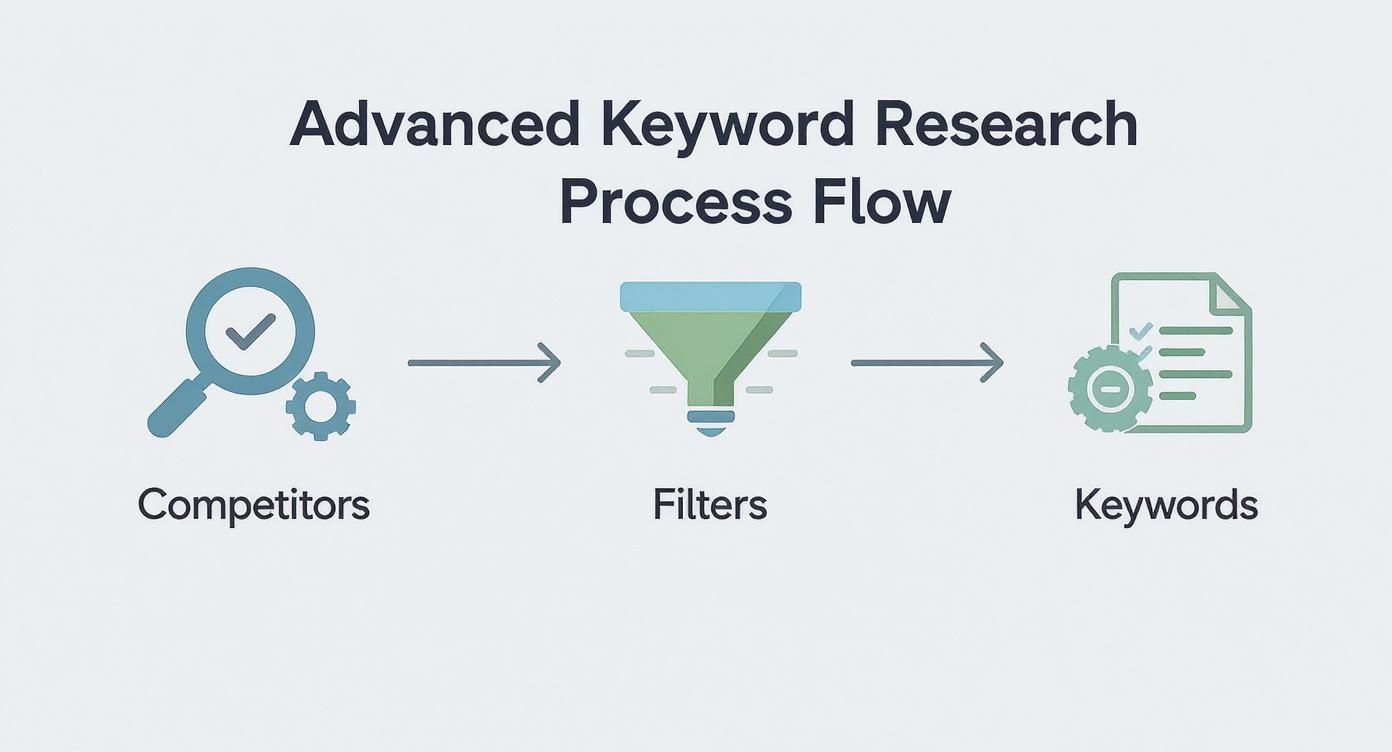
As you can see, just identifying keywords is the halfway point. It’s the filtering and prioritizing that pave the way for a strategy that actually works.
Categorizing Keywords for Your Content Funnel
After you've trimmed the fat from your list, the final piece of the puzzle is to sort each keyword by its intent. This tells you exactly what kind of content you need to create.
Prioritizing isn't just about picking the "best" keywords; it's about assigning the right keyword to the right job. A great blog post keyword will fail miserably on a product page, and vice versa.
I like to group keywords into three simple buckets:
- Informational: These are for your top-of-funnel content like blog posts and how-to guides. Think "how to choose a microphone for podcasting."
- Commercial Investigation: This is prime real estate for mid-funnel comparison pages or in-depth reviews. A classic example is "blue yeti vs shure mv7 review."
- Transactional: These keywords belong on your product or service pages where the goal is a direct purchase. Things like "buy blue yeti microphone online."
Once you've sorted your list this way, you're not just a keyword collector anymore. You're a strategist. You’ve built a content plan that guides people from their initial question all the way to a final purchase, making sure every single piece of content you create has a clear purpose.
Putting Your Long Tail Keywords into Action

Alright, so you’ve done the hard work and unearthed a fantastic list of long-tail keywords. That’s a huge first step, but it’s just that—the first step. The real magic happens when you start weaving these phrases into content that actually connects with your audience and, of course, gets the nod from search engines.
The goal here is to sound like a human, not a robot trying to check off boxes. This isn't about just dropping a keyword into a blog post a few times and calling it a day. It’s about using that long-tail phrase as the guiding star for an entire piece of content. Let it shape your structure, your headings, and the story you're telling to solve a very specific problem for a very specific person.
Weaving Keywords into Your Content Naturally
The best use of a long-tail keyword is to build a piece of content that becomes the definitive answer to the question behind it. If your keyword is “how to set up a home podcast studio on a budget,” your entire article should be the ultimate guide on exactly that. No fluff, no detours.
Start by placing your primary keyword and its close variations in the most important on-page SEO spots:
- Title Tag: This is its headline moment. Make it the star of the show, like "Your Complete Guide to a Home Podcast Studio on a Budget."
- Meta Description: Use the keyword here to write a compelling little ad for your article that makes people want to click.
- H1 and Subheadings (H2, H3): Let the keyword guide your outline. Break down the topic into logical steps using keyword variations in your headers.
This conversational approach has become even more important with the rise of voice search. Think about it: nearly half of all online searches are now done with voice assistants. People are asking full questions, like, “Who is the best cosmetic dentist in Brooklyn?” instead of typing “dentist Brooklyn.” This trend is a massive advantage for content built around specific, question-based long-tail keywords.
Build Authority with Topic Clusters
Instead of just writing one-off articles that exist in a vacuum, start thinking in terms of "topic clusters." This is an incredibly powerful SEO strategy. You create a main "pillar" page on a broad topic (like "Content Marketing") and then surround it with supporting "cluster" pages that target all the related long-tail keywords.
By creating a web of interlinked content around a central theme, you signal to Google that you are an authority on the subject. Each long tail article strengthens the entire cluster.
For example, your pillar page on content marketing could link out to cluster content targeting specific long-tail keywords, such as:
- “content marketing strategy for small business”
- “how to measure content marketing ROI”
- “best content distribution channels for B2B”
This structure doesn't just organize your site better for Google; it creates a fantastic, seamless journey for your reader, answering every follow-up question they might have. For a full walkthrough, our guide on building an essential content marketing strategy can help you map this out from scratch. And to really make sure every piece of content pulls its weight, understanding how to find long tail keywords that convert is absolutely critical.
At PromptDen, we believe that the right prompt can transform your entire workflow. Discover thousands of high-quality AI prompts for marketing, SEO, and content creation to bring your keyword strategy to life. Explore the community and find your next breakthrough at https://promptden.com.