
How to Make Money with AI A Practical Guide

Making money with AI really just means using these incredible tools to create something of value or offer a service someone needs. It can be anything from freelance AI-powered copywriting to building and selling your own AI art or automated workflows.
The trick is to spot a genuine need and figure out how AI can fill that gap way more efficiently than before.
The New Frontier of Earning with AI
We're in an era where "AI" isn't just a tech buzzword anymore—it's a real, practical tool for making a living. And the best part? The opportunities aren't just for developers or data scientists.
Creatives, marketers, and entrepreneurs are all jumping in, carving out profitable niches without touching a single line of code.
This wave of accessibility is fueling a whole new economy. Some projections even suggest AI could pour a staggering $15.7 trillion into the global economy by 2030. That number alone shows the sheer scale of the opportunity in front of us.
Finding Your Path in the AI Economy
The first move is always the same: match your current skills to a realistic AI money-making strategy. It doesn’t matter if you're a creative, a tech wizard, or a business strategist—there's a path for you.
Think of it like a decision tree. Your existing talents in creative, technical, or business fields can point you toward a specific corner of the AI economy.
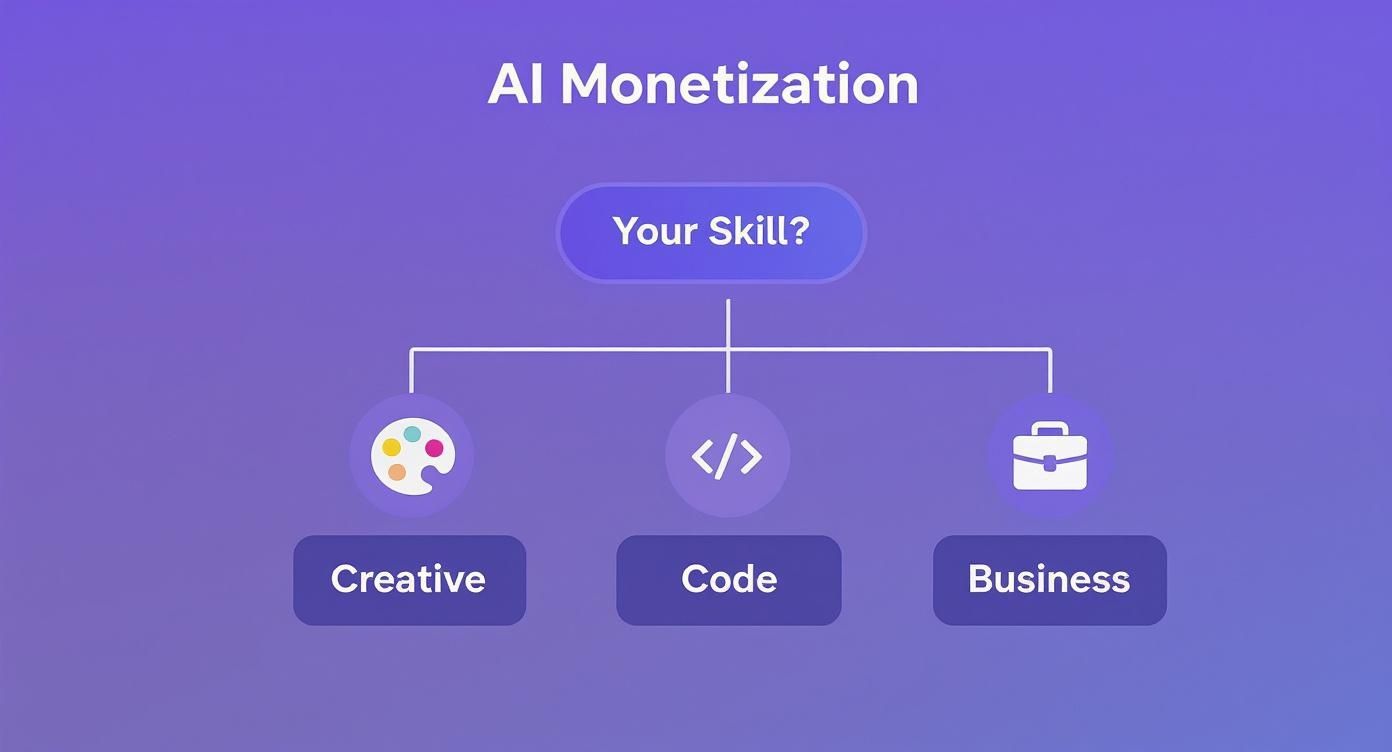
As you can see, each skill set unlocks different doors, from selling unique AI-generated art to building custom software for businesses. Figuring out where you fit is the key to picking a direction that feels right and gives you a better shot at success.
The most successful people in this space aren't always the most technical. They're the ones who truly understand how to solve a real-world problem with these new tools.
If you want a more structured way to get up to speed, checking out something like an AI Profit Masterclass can give you a solid foundation.
At the end of the day, the core idea is simple: use AI to do something faster, better, or in a completely new way that provides tangible value to someone else.
AI Monetization Pathways at a Glance
With so many options out there, it helps to see them laid out side-by-side. This table breaks down some of the most common pathways, giving you a quick look at what's involved and the potential payoff.
| Method | Required Skills | Income Potential (Low to High) | Best For |
|---|---|---|---|
| Prompt Engineering Services | Strong writing, creativity, understanding of AI models | Medium | Creatives and detail-oriented individuals |
| AI Consulting | Deep industry knowledge, strategic thinking, communication | High | Business strategists and subject matter experts |
| Selling AI-Generated Products | Artistic vision (for art), writing skills (for content) | Low to Medium | Artists, writers, and digital creators |
| Productizing Workflows | Technical proficiency, problem-solving, marketing | Medium to High | Developers, marketers, and entrepreneurs |
| Marketplace Prompt Sales | Creativity, understanding of market trends | Low | Hobbyists and those testing the waters |
Choosing a path isn't just about the potential income; it's about finding the sweet spot where your skills, interests, and market demand all come together. Use this as a starting point to explore what feels like the best fit for you.
Selling High-Demand AI Services
Let's get practical. The most direct path to making money with AI isn't some abstract theory—it's selling your expertise as a service. Businesses everywhere are scrambling to find people who can apply AI to solve real-world problems, from beefing up their marketing to making their internal operations run smoother. You don't need a Ph.D. in data science; you just need to be good with the right tools.
And the demand is absolutely exploding.
Why? The ROI is a no-brainer. Generative AI adoption has doubled to 65% in the last year alone. For every dollar companies sink into these technologies, they're seeing an average return of $3.70. That makes AI services a surprisingly easy sell for anyone who can deliver tangible results. If you want to dig deeper, just look at the latest AI adoption statistics—the momentum is undeniable.
This opens up a massive opportunity for freelancers and consultants who can package their skills into offers that businesses can't refuse.
Packaging Your AI Skills Into Compelling Offers
First things first: you need to translate your AI know-how into a service that solves a specific business pain point. Don't just call yourself an "AI expert." Frame what you do around the outcomes you create.
Think about what businesses are already paying for, and then figure out how AI makes it better, faster, or cheaper.
Here are a few high-demand service packages you could start with:
- AI-Powered Content Creation: Offer to write a month's worth of SEO-optimized blog posts, generate an entire social media calendar, or craft a high-converting email newsletter series—all in a fraction of the time it would take a traditional writer.
- Automated Social Media Management: Go beyond just writing posts. Use AI tools to schedule content, analyze engagement data to find the best posting times, and even generate eye-catching visuals. Clients will pay for a completely hands-off solution that grows their brand.
- AI-Driven SEO Audits: Use AI to tear apart a competitor's strategy, pinpoint profitable content gaps, and generate entire keyword clusters in minutes. Package this up as a comprehensive "SEO Roadmap."
- Custom AI Workflow Integration: Plenty of companies want to use AI but have no idea where to start. You could specialize in building custom AI assistants for their sales teams or automating repetitive tasks for their HR department. Our guide on AI automation for businesses is packed with ideas here.
The secret isn't just knowing how to use an AI tool. It's knowing how to plug it into a business process to save time, slash costs, or drive revenue. That’s the value clients will happily pay a premium for.
Finding Your First High-Paying Clients
Okay, you've got your service offerings ready. Now where do you find the clients?
Freelance marketplaces are the best place to get your feet wet. Why? Because the clients are already there, actively looking for people with your exact skills. Platforms like Upwork, Toptal, and Fiverr are overflowing with project listings for AI consultants.
Just take a quick peek at the jobs posted right now for an "AI Consultant" on Upwork.

Look at that variety—AI chatbot development, AI-powered marketing strategy, data analysis. This isn't some niche skill anymore; it's a diverse, healthy market with many clients offering rates well over $50 an hour.
When you're writing your proposal, always lead with the client's problem, not your resume. Acknowledge their specific challenge right upfront, then clearly explain how your AI-driven service is the solution. A winning proposal might lay out a simple three-step plan showing exactly how you'll use AI to hit their goals, making your pitch feel concrete and results-focused.
Setting Your Rates and Building a Business
Pricing your services can feel like a shot in the dark, but there are a few tried-and-true models that work great for consultants.
Common Pricing Models
- Project-Based Fees: Perfect for well-defined projects with a clear beginning and end, like an SEO audit or a batch of 10 blog posts. You quote one flat fee for the whole thing. Clients love this because it's predictable.
- Hourly Rates: Best for projects where the scope is a bit fuzzy or ongoing. This is common for general consulting or tasks where it’s hard to estimate the total time commitment upfront.
- Monthly Retainers: This is the Holy Grail for most freelancers. A retainer gives you stable, recurring income in exchange for a set amount of work or being on-call each month. It's the ideal model for ongoing services like social media management or content creation.
To start, hop on Upwork and see what others with similar skills are charging. Don't be afraid to charge what you're worth. As you land a few projects, build a portfolio, and collect testimonials, you'll have all the proof you need to confidently raise your rates.
Building a sustainable freelance business is all about demonstrating value, and with AI, you can deliver that value faster and more effectively than ever before.
Creating and Selling AI-Generated Products
Let's shift gears from services to something even more exciting: turning AI outputs into digital products you can sell. This is where you stop trading your time for money and start building assets that can bring in cash while you sleep. Instead of knocking out one-off client projects, you build something once and sell it again and again.
The concept is pretty straightforward. You use powerful generative AI tools to create something cool, package it up nicely, and list it on a marketplace where people are already looking for it. We're talking about everything from stunning digital art and custom illustrations to niche e-books and specialized prompt packs for other creators. Your one-time creative sprint can become a scalable, almost automated business.
Identifying and Dominating Niche Markets
The real secret to success here isn't just making something cool—it's making something people are actively looking for and happy to pay for. Before you even think about firing up Midjourney or DALL-E, your first job is to become a market detective.
Go hang out on platforms like Etsy, Gumroad, and Amazon KDP. What's selling? What themes, styles, and topics keep popping up?
Look for the gaps. Sure, "vintage watercolor cat portraits" might be a crowded market, but what about "cyberpunk-style cat portraits for gamers"? That could be wide open. Your mission is to find a specific, passionate audience and create products that speak directly to them.
Once you’ve locked onto a niche, you can use AI to flood it with a variety of products. For instance, if you're targeting fantasy readers, you could create:
- A pack of 20 high-resolution digital dragon illustrations for tabletop RPGs.
- An e-book of AI-generated short stories set in a mythical world.
- Printable fantasy-themed bookmarks featuring unique AI art.
This lets you build an entire digital storefront around a single, profitable idea, making you the go-to person in that little corner of the internet.
From AI Prompt to Profitable Product
With a clear niche in mind, the fun part starts. Turning an idea into a digital product has never been faster, thanks to AI. Let's walk through a real-world scenario of creating and selling AI art.
Imagine you've spotted a demand for minimalist, abstract digital art for home decor.
First up is generation and refinement. You’d jump into an AI image generator like Midjourney with some carefully crafted prompts. You might start with something like, "minimalist abstract art, calm blue and gold tones, textured brush strokes, high resolution, suitable for printing." You'll probably generate dozens of options, cherry-pick the absolute best, and maybe do some minor touch-ups in an image editor.
Next, it's all about packaging and presentation. Don't just sell a lonely JPG file. That’s a rookie mistake. Create mockups that show your art framed and hanging on a stylish wall. Bundle five matching pieces together as a gallery set. And critically, provide the art in multiple aspect ratios (like 2:3, 3:4, 4:5) to fit standard frame sizes. This adds a ton of perceived value.
The final piece is listing and marketing. You need to get your product in front of buyers, and marketplaces are your best friend here. For anything visual, Etsy is an absolute powerhouse.
Just take a look at the bustling AI art marketplace on Etsy right now.
See how the top sellers aren't just uploading raw images? They're using gorgeous mockups, offering bundles, and targeting specific keywords like "nursery wall art" or "boho decor." This is exactly how you stand out and turn your AI creations into a consistent stream of sales.
If you’re just getting started with product creation, this beginner's guide for creating digital products that sell is packed with foundational tips that apply perfectly to AI-generated goods.
Choosing the Right Marketplace
Where you sell your product is just as important as the product itself. Different platforms attract different crowds. You’ve got to match your product to the platform where your ideal customers are already hanging out.
The best platform isn't the one with the most users; it's the one with the most of your users. Selling AI-generated business plan templates on an art-focused site is a recipe for zero sales.
Here's a quick cheat sheet to get you thinking:
| Platform | Best For | Audience | Key Advantage |
|---|---|---|---|
| Etsy | Art, printables, design assets, crafts | DIYers, home decorators, gift shoppers | Massive, built-in audience actively looking for creative goods. |
| Amazon KDP | E-books, low-content books (journals) | Readers, knowledge seekers | Unmatched reach and a trusted purchasing experience. |
| Gumroad | Prompt packs, templates, tutorials | Creators, developers, professionals | Simple setup and direct connection with your audience. |
| Creative Market | Fonts, graphics, website themes | Designers, marketers, agencies | A curated marketplace for high-quality design assets. |
Making the right choice early on can make a huge difference in your sales and visibility. For a much deeper dive, our guide on the best platforms to sell digital products will help you pick the perfect home for your AI creations. Building a portfolio of digital products is a powerful, sustainable way to start making money with AI.
Building Your Own Simple AI Tools
Beyond offering services or selling prompts, there's another, more scalable path to making money with AI: building your own simple tools. For a long time, this was a world reserved for developers who could sling code. Not anymore. The rise of no-code and low-code platforms has completely changed the game, opening the door for anyone with a good idea.
This is all about productizing a solution. Think of it like this: instead of getting paid once to solve one person's problem, you build an asset that solves the same problem for hundreds or thousands of people. Maybe it's a specialized chatbot for local restaurants to handle reservations, or a custom resume builder that uses AI to suggest powerful edits. You're building something that works for you, even when you're not.
From Problem to Prototype with No-Code Platforms
The first step isn't about code; it's about spotting a real-world problem AI can fix. The best ideas usually come from your own headaches. What's that one repetitive task in your day job you wish you could just automate? What's a common struggle in your industry that doesn't have an easy, affordable fix? These pain points are where great tool ideas are born.
Once you’ve got an idea, you can bring it to life with platforms like Bubble, Voiceflow, or Softr. These tools let you build surprisingly complex web apps using visual, drag-and-drop interfaces. You can connect them to powerful AI APIs without writing a single line of code.
Here's a quick look at what Bubble's interface is like. It's more like designing a presentation than building software.

The whole point here is to get a Minimal Viable Product (MVP) out the door. Don't try to build the perfect, feature-packed tool from day one. Build a basic, functional version that solves the core problem, launch it quickly, and see what real users have to say.
Choosing Your Monetization Model
Okay, so you've built a prototype. Now, how do you actually get paid? Your monetization strategy needs to match the value your tool provides and who you're selling it to. There are a few tried-and-true models to think about.
- Monthly Subscription (SaaS): The classic Software-as-a-Service model. Users pay you a recurring fee (monthly or yearly) for access. This is perfect for tools that offer ongoing value—like an AI-powered social media scheduler—and it gives you predictable, stable income.
- One-Time Purchase: Super simple. A customer pays a single upfront fee for lifetime access. This works really well for tools that solve a specific, one-off problem, like an AI resume builder or an e-book generator.
- Usage-Based Pricing: This is a "pay-as-you-go" model. Customers are charged based on how much they use the tool. Think charging per generated report, per chatbot conversation, or per 1,000 words analyzed. It's a fair model because users only pay for the value they actually get.
- Freemium Model: You offer a basic, feature-limited version of your tool for free to attract a big user base. The goal is to get them to upgrade to a paid plan for the really good stuff. This is a fantastic way to lower the barrier to entry and let the product sell itself.
Your first attempt at pricing probably won't be perfect, and that's okay. Launch with one model, listen carefully to your first users, and don't be afraid to change things up. The most successful tools are the ones that evolve based on what customers actually need and are willing to pay for.
A Real-World Scenario
Let's put this into practice. Imagine you're a freelance writer who is absolutely sick of creating content briefs from scratch. It's a time sink.
You could use a platform like Bubble to build a simple tool. You pop in a target keyword, and the tool scrapes and analyzes the top-ranking articles, then spits out a comprehensive brief—complete with recommended headings, word count, and related keywords.
You could launch this MVP with a simple one-time purchase model for $49. After getting feedback from your first 100 customers, you notice a pattern: they love it, but they keep asking for more. They want ongoing rank tracking and competitor analysis.
That feedback is gold. It's a clear signal that it's time to introduce a subscription model. You could create a $29/month Pro plan that includes those advanced features, instantly creating a new, recurring revenue stream.
This whole cycle—spotting a problem, building a simple fix, and then refining it based on real market feedback—is the blueprint for successfully building and selling your own AI tools.
Mastering Prompt Engineering for Profit
Prompt engineering has blown up, going from a niche tech hobby to one of the most valuable skills in the AI game. At its core, it's the art of having a conversation with artificial intelligence, and getting good at it means you can create incredible, consistent results. This is where you can turn a knack for writing clever instructions into a real business.
When you start thinking like a prompt engineer, you leave simple one-liners in the dust. It’s all about layering instructions, giving the AI context, and steering it toward a very specific, high-quality outcome. The difference between a basic and an advanced prompt is night and day—it's what separates a generic, throwaway response from a polished, client-ready final product.

This skill is the launchpad for a few seriously lucrative paths. You could offer your brain as a consultant, build ready-to-use prompt packs for others, or help businesses overhaul their existing AI workflows. If you need to back up a bit and nail the fundamentals first, our practical guide on what is prompt engineering is the perfect place to start.
Become a Prompt Engineering Consultant
One of the most direct ways to make money here is by hanging out your shingle as a prompt engineering consultant. Companies everywhere are pouring money into AI tools but often don't have anyone in-house who really knows how to use them. They're getting spotty results, burning through time, and just can't seem to get AI integrated properly.
That's your cue. You can step in and offer services like:
- Workflow Optimization: Dig into a company’s content or marketing pipeline and build out custom prompts that automate and elevate their output.
- Team Training: Run workshops for a company's team, teaching them how to write better prompts that are tailored to their specific roles and goals.
- Custom Prompt Development: Create a whole library of bespoke prompts for a client, designed to nail their brand voice and deliver consistently high-quality results.
Your value proposition is simple but incredibly powerful: you help businesses save time and generate more revenue by making their AI tools smarter. You're not just a writer; you're an AI-powered efficiency expert.
Create and Sell High-Value Prompt Packs
Another fantastic route is to productize your expertise by selling curated prompt packs on digital marketplaces. Countless creators, freelancers, and small business owners want amazing AI results but simply don't have the time to go down the prompt engineering rabbit hole. They are more than happy to pay for a pre-built solution that solves a problem for them right now.
The secret is to get hyper-specific and focus on a high-demand niche. Don't just make a generic "marketing prompts" pack. Go deeper.
- For instance: A prompt pack for real estate agents that churns out compelling property descriptions, social media posts for new listings, and lead-nurturing emails for potential buyers.
- Or maybe: A bundle of prompts for indie authors to help them outline novels, flesh out character backstories, and brainstorm clever plot twists.
- Another idea: A "brand identity" toolkit for startups, loaded with prompts for generating mission statements, brand voice guidelines, and even initial logo concepts.
These kinds of targeted products solve a clear and urgent problem for a well-defined audience, which makes them an incredibly easy sell. You can offer them on your own website or use platforms like Gumroad and Etsy.
The most profitable prompts aren't just clever—they're built like a template. They include placeholders, clear instructions, and examples that make it easy for anyone to adapt them to their own needs.
Basic Prompt vs Advanced Prompt Comparison
To really grasp the value you're offering, it helps to see the stark difference a well-engineered prompt makes. This is the magic you're selling—the ability to take an AI's output from "meh" to "masterpiece."
The table below shows just how much impact a little bit of prompt engineering can have on the final result.
| Task | Basic Prompt Example | Advanced Prompt Example | Result Improvement |
|---|---|---|---|
| Blog Post Intro | "Write an intro about AI in marketing." | "Act as a senior content strategist. Write a 100-word intro for a blog post targeting CMOs. The tone should be authoritative but accessible. Start with a surprising statistic about AI adoption and end with a question that hooks the reader." | The advanced prompt produces a targeted, tone-specific intro with a clear hook, while the basic one gives a generic, uninspired paragraph. |
| Social Media Post | "Create a tweet about our new product." | "Craft 3 tweet variations for the launch of 'SynthFlow,' an AI workflow tool. Highlight the key benefit of saving 10 hours/week. Include the hashtag #AIAutomation and use an emoji. Keep it under 280 characters." | This provides multiple, ready-to-use options that are optimized for the platform and focused on a specific user benefit. |
As you can see, the quality isn't just a little better; it's in a different league entirely. This is the transformation you can offer, whether through consulting or selling your own custom prompt packs.
Got questions about turning AI skills into actual money? You're not alone. It's a new frontier, and it’s natural to wonder where the real opportunities are. Let's cut through the noise and get straight to the answers you're looking for.
My goal here is to give you the practical, no-fluff insights you need to get started or refine your game plan.
What Is the Easiest Way for a Beginner to Start?
Hands down, the simplest entry point is offering AI-powered freelance services. You don't need to build a product from scratch, grow a massive audience, or dump a bunch of cash upfront. You're just using off-the-shelf AI tools to do things for clients, only way faster.
Think about the tasks businesses are already paying for every single day—tasks that AI can supercharge.
- Content Creation: Pitch yourself as a blog post or social media writer. You can use AI assistants to generate first drafts and then spend your time polishing them into something great.
- Basic Graphic Design: Small businesses need graphics constantly. Use AI image generators to whip up social media posts, blog headers, or even simple logos.
- Data Entry and Summarization: This is a classic freelance gig. Offer to take a client's messy documents, long transcripts, or dense spreadsheets and use AI to process and summarize the key takeaways.
The trick is to start with what you already know. If you're a decent writer, stick with content. If you've got a good eye for visuals, focus on AI art. It’s the fastest way to start earning while you get your sea legs with the tech.
Can You Realistically Generate Passive Income with AI?
Yes, absolutely. But let's be real about what "passive" means. It's not about doing nothing; it's about doing the work once and getting paid for it over and over. You put in a heavy lift upfront to create something valuable, and AI just makes that creation process a whole lot easier.
True passive income from AI is about front-loading your effort. You use AI to build a valuable asset once, then you set up systems to sell it over and over again without your direct involvement.
Let’s look at a few models:
| Model | Upfront Work | Ongoing Work | Best For |
|---|---|---|---|
| Selling Digital Products | High (Creating art, writing e-books, building prompt packs) | Low (Marketing, customer service) | Creatives, Writers, Prompt Engineers |
| Affiliate Marketing | Medium (Writing reviews, creating content) | Medium (Updating content, SEO) | Bloggers, Content Creators |
| Building a SaaS Tool | Very High (Development, design, testing) | High (Maintenance, support, updates) | Entrepreneurs, Technologists |
For a concrete example, imagine spending a weekend with Midjourney creating a unique pack of 50 digital art prints for a super-specific niche, like "vintage botanical illustrations." Once you list that pack on a marketplace like Etsy, it can keep selling for months or even years. That's a powerful passive income stream built in a single weekend.
How Much Money Can You Actually Make?
This is the big question, and the honest answer is: it's all over the map. Your income depends entirely on the path you take, how good you get, and how well you market yourself.
An AI-powered freelance writer on Upwork might start out making 25-50 per hour. But once they build a solid portfolio and find a specialty, that rate can easily jump past $100 per hour.
If you're selling AI-generated digital products on Etsy, you might only make a couple hundred bucks a month at first. But the top sellers who find a hot niche and build a large catalog of products? They can pull in thousands a month, and most of that is passive.
The highest ceiling is building your own AI tool or micro-SaaS. It’s also the riskiest. A successful, simple tool could bring in anywhere from 1,000 to over 10,000 per month in recurring revenue. But that path demands a serious commitment to building and selling a real product.
What Are the Most Important Skills to Learn First?
The world of AI is massive, but you don't need to learn it all at once. If you focus on just a few high-impact skills, you'll get much further, much faster. These are the fundamentals that apply to almost any money-making strategy you choose.
If I had to pick the top three, they'd be:
- Prompt Engineering: This is non-negotiable. Learning how to talk to AI models is the master key. It's the difference between getting a bland, generic response and producing a professional-grade asset you can actually sell.
- Niche Identification: You need to get good at spotting problems. Look for underserved markets or specific pain points that AI is uniquely suited to solve. This means doing your research and finding gaps where you can offer something nobody else is.
- Digital Marketing Basics: You can have the most amazing AI service or product, but if nobody knows it exists, it's worthless. You have to learn the basics of getting in front of customers, whether that's through simple SEO, social media, or just learning how to write a compelling sales page.
Don't feel like you need to become a world-class expert in all three overnight. Get really good at prompt engineering first. Then, as you start building, layer in your niche research and marketing skills.
Ready to get your hands dirty? The only way to really learn is by doing. PromptDen is the perfect place to master your prompt engineering skills and discover workflows that actually work. Browse our marketplace, see what others are creating, and start your own AI income journey today.