
How to Sell AI Art: A Practical Guide to Online Success

If you want to sell AI art, the path is pretty straightforward: you'll need to lock down a unique artistic style, pick the right place to sell your work (like Etsy or a print-on-demand shop), and get the word out on social media. The real trick is turning your AI-generated images into a brand people recognize and connect with. This guide will show you exactly how to navigate this exciting new world.
Your Guide to the AI Art Marketplace
Welcome to the new creator economy. The world of AI art isn't just a fascinating artistic movement; it's a booming commercial frontier. This market is seeing some pretty explosive growth, too. We're talking a projected compound annual growth rate of about 40%, ballooning to roughly **8.6 billion by 2033** from a mere 298.3 million in 2023.
Right now, creative pros—artists, designers, and digital creators—make up a solid 40% of this market, which tells you just how much they’re leaning into generative AI. This kind of growth is a massive signal that now is the time to turn your digital creations into a real business. But where do you even start? Success takes more than just hitting "generate" on an image.

Core Pillars of an AI Art Business
To build something that lasts, you need to get three things right: your craft, your commercial strategy, and your compliance. Think of these as the legs of the stool your business will stand on.
Here’s the breakdown:
- Refining Your Craft: This is about moving beyond basic prompts to develop a signature style that makes your work instantly recognizable. Getting comfortable with different text-to-image models is the first step. If you need to brush up on your skills, you can check out our guide to modern text-to-image models to go deeper.
- Mastering Commerce: It's absolutely crucial to figure out the best platforms for your art. Is it a bustling marketplace? A curated online gallery? Once you know where you're selling, you have to learn how to market your work effectively to the right people.
- Navigating Compliance: You've got to understand the legal side of things. This means knowing the limitations of copyright for AI art and getting familiar with the specific terms of service for any platform you sell on. Getting this right lets you sell your work confidently and ethically.
The key is to treat your AI art like a legitimate business from day one. This means developing a real brand, understanding who you're selling to, and creating a consistent, high-quality product that people genuinely want to buy.
This guide is designed to be a clear roadmap, not just a bunch of guesswork. We’ll walk you through every phase of the process, from finding your artistic voice to building a base of loyal customers.
To help you get started right away, here's a quick-start table that summarizes the essential steps. It’s an at-a-glance overview of what it takes to sell your very first piece of AI art.
Quick Start Guide for Selling AI Art
This table breaks down the core phases of launching your AI art business, from creation to your first sale.
| Phase | Key Action | Why It Matters |
|---|---|---|
| 1. Creation | Develop a unique, recognizable style using advanced prompting. | A consistent style builds a brand and helps you stand out in a crowded market. |
| 2. Production | Upscale images to high resolution for printing and digital sales. | Quality is non-negotiable. Low-res art looks unprofessional and won't sell. |
| 3. Platform Selection | Choose the right marketplace (e.g., Etsy, Society6, your own site). | Different platforms attract different buyers. Your choice dictates your audience. |
| 4. Marketing | Promote your art on social media where your target audience hangs out. | You can't sell what people don't see. Consistent marketing drives traffic and sales. |
| 5. Legal & Compliance | Understand copyright rules and platform-specific terms of service. | This protects you legally and ensures your business is built on a solid foundation. |
Following these steps will put you on the right track to turning your passion for AI art into a profitable venture.
Develop an Artistic Style That Sells
In a marketplace absolutely flooded with AI-generated images, just being "good" isn't enough. You have to be memorable. The real secret to selling AI art isn't about that one perfect image; it's about crafting a signature style that people recognize as yours.
Think of it this way: a unique artistic voice transforms random generations into a cohesive, recognizable portfolio. That's what attracts serious buyers and builds a loyal following. It means you need to stop being a prompt operator and start acting like an art director, guiding the AI with clear intention. This is the line between a hobbyist and a professional who knows how to sell AI art online.
Crafting a Signature Style with Advanced Prompts
A signature style isn't magic—it's born from the details you meticulously control. Instead of a generic prompt like "a fantasy landscape," you need to start defining the mood, the lighting, the color palette, and the exact composition. This is where sophisticated prompting comes into play.
What makes your art your art? Is it the haunting, melancholic feel of your portraits? The vibrant, neon-soaked colors in your cityscapes? Or maybe it's a unique fusion of styles, like "cyberpunk art deco."
Here are a few ways to start baking your unique style directly into your prompts:
- Pinpoint an emotional tone: Use powerful words like "serene," "eerie," "energetic," or "nostalgic" to set the entire feeling of the piece.
- Define the lighting: Don't leave it to chance. Terms like "golden hour lighting," "dramatic backlighting," or "soft, diffused light" can completely transform a scene.
- Control the composition: Start thinking like a photographer. Use camera-specific language such as "wide-angle shot," "macro detail," or "from a low angle" to frame your subject with purpose.
A simple prompt for a "robot in a forest" becomes something much more compelling: "cinematic shot, a lonely rusty robot in a foggy redwood forest, soft morning light filtering through the canopy, moody and introspective, wide-angle lens." That level of specificity is your first step toward building a body of work that feels connected. For a deeper dive into this, our Midjourney prompts guide is packed with insights for creating truly stunning AI art.
Take a scroll through any major AI art platform, and you'll see this intentionality everywhere.
This gallery is a perfect example. The top creators aren't just hitting "generate" and hoping for the best. They're masters of a specific style—from hyper-realism to classic anime—and they use it to build a consistent and instantly recognizable portfolio.
The Human Touch: Post-Production and Upscaling
The raw output from an AI generator is almost never the finished piece. The artists who are truly succeeding are the ones who use post-production to refine, correct, and inject that irreplaceable human element. This is where your artistry shines, and it's how you fix those classic AI quirks, like bizarre hands or distorted faces.
Think of the AI as your creative partner, not the sole creator. The initial generation is just the starting point. Your real value comes from the curation, editing, and enhancement you perform afterward.
Tools like Adobe Photoshop, Procreate, or the open-source GIMP are absolutely essential for this stage. You can blend multiple AI generations, paint over imperfections, fine-tune the colors, and add textures that make the piece truly yours. This hybrid approach is what leads to the most compelling—and sellable—work.
Another step that is completely non-negotiable is upscaling. Standard AI outputs are often way too low-resolution for professional printing. Selling a pixelated print is a surefire way to get a bad review and lose a customer for good.
You have to use AI upscaling tools like Gigapixel AI or one of the many free alternatives to boost your image resolution to at least 300 DPI (dots per inch). This is the industry standard for high-quality prints. It ensures your physical products look crisp and professional, whether it’s a small postcard or a massive wall canvas. This one-two punch of advanced prompting and meticulous post-production is how you create a premium product that justifies a higher price and builds a reputation for quality.
Find the Best Platform to Sell Your Art
Alright, you've spent the time developing a unique artistic style with AI. Now for the million-dollar question: where do you actually sell it?
Picking a marketplace isn't just about uploading a file and hoping for the best. The platform you choose dictates who sees your work, what you can charge, and ultimately, how much you can grow. This one decision can be the difference between a few hobby sales and building a real, sustainable business.
When you're figuring out how to sell AI art, the first step is to Find the Best Platform to Sell Digital Products that matches your goals. Are you dreaming of passive income from t-shirts and mugs, or are you aiming to build a high-end portfolio as a serious digital artist? The path you take starts here.
Before you jump in, it's worth taking a quick self-assessment. Does your art have a distinct, recognizable style? Is it high-resolution and ready for printing?
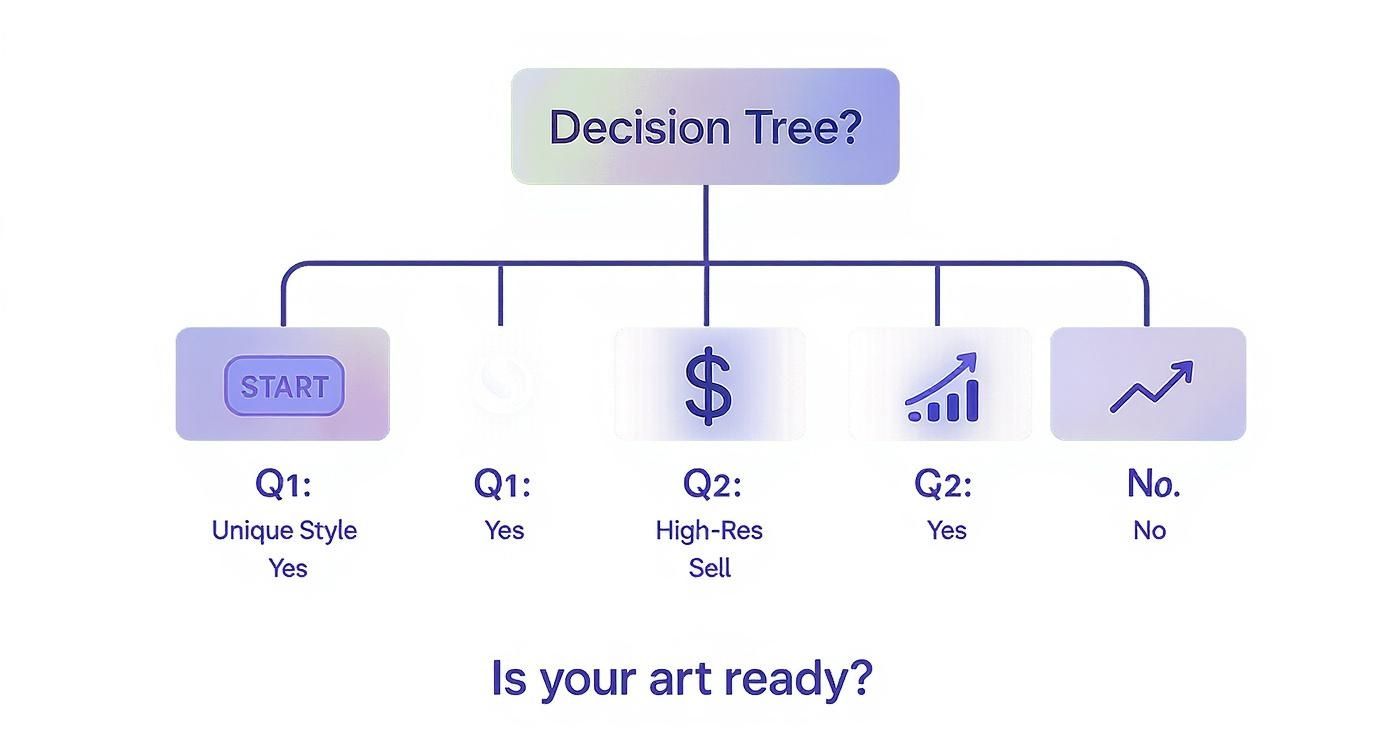
This simple check ensures you're not just selling something generic. The market is getting crowded, so having a unique voice and technically sound files is your first real hurdle.
Print-on-Demand for Passive Income
If you love the idea of making money while you sleep, print-on-demand (POD) is your best friend. This is probably the easiest entry point for any AI artist.
Platforms like Printful, Printify, and Society6 are logistics wizards. They handle all the messy stuff—printing, packing, shipping, returns—so you can stick to what you do best: creating art.
The process is incredibly simple:
- You upload your high-resolution artwork.
- You choose which products to put your art on (think t-shirts, posters, phone cases, mugs).
- When someone buys an item, the POD service makes it and ships it directly to them.
- You collect a commission on every sale. Easy peasy.
This model is a dream for building passive income. Imagine creating a killer series of vibrant, abstract patterns. You could splash those designs across dozens of products on a site like Redbubble and tap into a huge audience actively looking for cool, unique stuff for their homes and wardrobes.
Digital Marketplaces for Direct Sales
Maybe you'd rather sell your digital files directly to customers. If you want more control over your products and pricing, then digital marketplaces like Etsy and Creative Market are where you should look.
Here, you're essentially running your own little digital shop. It's a bit more hands-on, but the possibilities are huge.
This route is perfect for selling:
- Digital Downloads: High-resolution prints that customers can download and print themselves.
- Digital Assets: Things like seamless patterns for designers, character portraits for D&D players, or cool backgrounds for YouTubers.
- Custom Work: You can even offer personalized AI art commissions.
For instance, an artist who’s great at generating fantasy characters could open an Etsy shop selling bundles of pre-made character portraits for tabletop gamers. You’re targeting a niche, passionate community and get to interact directly with the people buying your art.
The secret to winning on big marketplaces is getting your in-platform SEO right. Using the right keywords and tags is everything. It’s how people find your stuff among the millions of other listings.
Curated Platforms for Professional Artists
If your goal is to be seen as a professional artist and sell premium, high-end prints, you'll want to aim for curated platforms like ArtStation and Saatchi Art.
Think of these sites as the digital art galleries of the internet. They’re less about selling tons of cheap items and more about showcasing high-quality, exclusive work to serious collectors and industry pros.
Getting your art accepted often involves a review process, but the reward is huge: a discerning audience that’s willing to pay top dollar for incredible work. This is the path for an artist who has truly polished their style. Selling a limited series of signed, high-resolution prints on ArtStation doesn't just make you money—it builds a portfolio that can lead to freelance gigs or even gallery representation.
The art world is taking AI seriously, too. The global market for AI-generated art is expected to reach $5.3 billion by 2025. Even more telling, a surprising 35% of fine art auctions now include AI-created works, showing a massive shift in how collectors see this medium. This isn't just a fleeting trend; it’s a validation that your work belongs on more exclusive platforms.
Platform Comparison for Selling Your AI Art
Choosing a platform can feel overwhelming, so let's break down the options based on what you're selling and who you're trying to reach. This table should help clarify which path is the best fit for your specific type of AI art.
| Platform Type | Examples | Best For | Key Consideration |
|---|---|---|---|
| Print-on-Demand | Redbubble, Printful, Society6 | Physical goods like apparel, mugs, posters, and home decor. Ideal for passive income. | Hands-off fulfillment, but lower profit margins per sale. Success depends on volume and trends. |
| Digital Marketplaces | Etsy, Creative Market | Digital downloads, art prints, asset packs (patterns, icons), and custom commissions. | Higher profit margins and direct customer interaction. Requires self-promotion and shop management. |
| Curated Art Platforms | ArtStation, Saatchi Art, Foundation | High-end limited edition prints, fine art, and professional portfolio-building. | Attracts serious collectors and offers higher price potential. Often requires an application or review to be accepted. |
| Stock Photo Sites | Adobe Stock, Shutterstock | High-quality images and illustrations for commercial licensing. | Reach a massive commercial audience, but per-image earnings can be low. Requires adherence to strict quality standards. |
Ultimately, the "best" platform is the one that aligns with your art, your audience, and your long-term goals. Don't be afraid to start with one and expand to others as you grow.
Market Your Art and Build an Audience
So you’ve created some amazing AI art. That's fantastic, but it's only half the job. The other, arguably harder, half is getting people to actually see it. Let's be real: without a smart marketing effort, even the most incredible artwork will just gather digital dust.
Your strategy needs to be visual, authentic, and focused on building a real community—not just racking up vanity metrics like followers.
This means you have to get clever about how you show your work. Just posting a final image and calling it a day isn't going to cut through the noise of a crowded social feed. You need to pull back the curtain, tell the story behind your art, and give people a reason to connect with you as a creator.
Master Visual-First Platforms
Platforms like Instagram, Pinterest, and TikTok should be your new best friends. They're built for visual discovery, which means your potential buyers are already there, scrolling for inspiration. Your job is to make them stop.
Instead of just a static feed of finished pieces, mix things up to keep your audience hooked:
- Show Your Work: Create short, snappy time-lapse videos of your post-production process. Record your screen as you jump into Photoshop or Procreate to clean up an AI generation, fix weird artifacts, or dial in the colors. This shows off the human skill and effort involved.
- Use Mockups: Don't just sell an image; sell a vision. Use mockup templates to show people what your art could look like in their life. Display your prints on a gallery wall, your designs on a t-shirt, or your patterns on a throw pillow. This makes your art feel tangible and far more desirable.
- Tell a Damn Good Story: That caption box isn't just for the title. Share the wild prompt that finally worked, the feeling you were trying to evoke, or the weird dream that inspired the piece. A story creates an emotional hook that a simple image can't.
Your social media feed shouldn't just be a sterile gallery of your final art. Think of it as a living, breathing portfolio that documents your entire creative journey. This narrative is what makes your art—and you—memorable.
Optimize for Marketplace Discovery
If you're selling on a platform like Etsy or Redbubble, you need to put on your business owner hat and get comfortable with search engine optimization (SEO). Marketplace SEO is simply how new customers find you when they're searching for something specific.
Start by getting inside your ideal customer's head. What words are they typing into that search bar? Are they looking for "dark academia wall art," a "cyberpunk phone case," or maybe an "ethereal fantasy landscape print"? Those are your keywords.
You'll want to use a healthy mix of broad and super-specific keywords (often called tags) in your product titles, descriptions, and tag fields. For example, a piece featuring a futuristic city could be tagged with:
- Broad terms:
sci-fi art,cityscape,digital print - Specific terms:
neon noir,cyberpunk decor,dystopian city,futuristic wall art - Style terms:
synthwave aesthetic,bladerunner style,AI generated art
Do some recon! See what tags and titles the best-selling items in your niche are using. This isn't about ripping them off; it's about learning the language your customers speak. This kind of planning is fundamental to any online venture, and our guide on creating an essential content marketing strategy covers more of these foundational principles.
Build a Thriving Community
The absolute best way to sell your art for the long haul is to build a genuine community around your work. We're talking about turning passive followers into loyal fans—the kind of people who get genuinely excited about what you're going to make next.
Authentic engagement is your superpower here. When people comment, respond to them. Ask for feedback on new ideas. Don't just broadcast your art into the void; connect with people.
Here are a few community-building ideas to get you started:
- Collaborate with Other Artists: Find another AI artist whose style vibes with yours and team up. You could do a joint collection around a theme or a simple social media shoutout swap. Cross-promotion is a fantastic way to get in front of a whole new, highly relevant audience.
- Start an Email Newsletter: Social media algorithms are fickle beasts, but your email list is an asset you completely own. Offer a freebie—like a cool phone wallpaper of your art—to get people to sign up. Use it to share new work, announce sales, and give subscribers exclusive behind-the-scenes peeks.
- Get Active in Niche Communities: Don't just stick to your own profiles. Participate in relevant subreddits, Facebook groups, or Discord servers that are all about AI art or your specific themes (like fantasy art or abstract design). Share your work, give advice, and become a valued member.
Building an audience doesn't happen overnight. It takes time and consistency, but it's an investment that pays off big time. A strong community doesn't just buy your art; they become your biggest cheerleaders, spreading the word and helping your creative business grow.
Understand Copyright and Commercial Use
So, you want to sell your AI art? Awesome. But before you dive in, we need to talk about the legal stuff. It’s a bit of a wild west right now, with rules still being written, but getting a handle on copyright and commercial rights is non-negotiable. It’s what separates a real business from a hobby that could land you in hot water.
The biggest question on everyone's mind is: who actually owns the art? When you type in a prompt and an AI spits out an image, the answer isn’t as clear-cut as you might think. It all boils down to the fine print in the terms of service for whatever AI platform you’re using.
Navigating Platform Terms of Service
Think of each AI generator's terms as your rulebook. You absolutely have to read them. Ignoring this step is the fastest way to get into trouble down the line.
- Midjourney: If you’ve got a paid subscription, you’re generally in the clear. Midjourney gives you ownership of the assets you create, so you can sell them commercially. The free trial, however, is a different story—commercial use is a no-go.
- Stable Diffusion: Being open-source, Stable Diffusion is much more permissive. The images you generate are typically yours to use however you see fit, without any ongoing fees. The big caveat here is making sure your prompts don't infringe on someone else's intellectual property.
- DALL·E 3: OpenAI is pretty straightforward. They grant you full ownership of your creations, which includes the right to sell and merchandise them. This applies to both free and paid users.
Here’s the bottom line: Your rights are defined by the tool you use. Don't assume anything. Always check the terms before you even think about listing a piece for sale.
The U.S. Copyright Office Stance
The legal world is playing catch-up, and you can see why. It’s estimated that as of 2025, a mind-boggling 34 million AI images are generated every single day. Since 2022, that number has ballooned to over 15 billion images. This explosion of content has forced official bodies to take a stand.
For now, the U.S. Copyright Office is firm: a work created entirely by an AI, with no human author, cannot be copyrighted.
This screenshot is taken directly from their official guidance on the matter.
The key takeaway is that copyright law is designed to protect human creativity. But here’s the interesting part: if you take an AI-generated image and significantly alter it—maybe you’re compositing it with other elements, doing heavy-duty editing, or adding your own artistic flair—you might be able to copyright your contributions to the final piece.
An Actionable Checklist for Ethical Selling
To stay on the right side of this, knowing what is intellectual property protection is crucial for any serious AI artist. Honestly, operating with integrity isn't just about ethics; it's just plain good business.
Here’s a practical checklist to keep you on the straight and narrow:
- Disclose Your Process: Just be honest with people. Let your customers know your art was made with AI. Transparency builds trust and helps you find an audience that genuinely appreciates the medium.
- Respect Intellectual Property: This one is huge. Don’t use prompts that name living artists or copyrighted characters. Prompts like "in the style of [artist's name]" or anything involving Mickey Mouse are legal minefields and, frankly, disrespectful to other creators.
- Add Your Human Touch: Your job isn't done when the image is generated. Get in there with tools like Photoshop or Procreate. Combine different elements, tweak the colors, paint over sections, and fix imperfections. The more of you in the final piece, the stronger your claim to it is.
- Keep Meticulous Records: Document everything. For each piece, log which AI platform you used, the exact prompts, and all the post-production work you did. If your ownership ever gets questioned, this paper trail could be a lifesaver.
Common Questions About Selling AI Art
Diving into the world of selling AI art always brings up a few nagging questions. It’s a new frontier, after all, and it's totally normal to feel a little unsure about the rules of engagement. Let's clear up some of the most common hurdles so you can get started with confidence.
Figuring this stuff out is a huge part of learning how to sell your work successfully. When you're clear on the legal, practical, and ethical sides of the business, you're building your creative venture on solid ground.
Is It Really Legal to Sell Art Made with AI?
The short answer is yes, it's generally legal to sell AI-generated art. But the devil is truly in the details.
Your right to sell anything you create hinges entirely on the terms of service of the specific AI tool you’re using. You absolutely have to read them. For instance, a paid plan on a platform like Midjourney typically gives you broad commercial rights to your generations. That means you're good to go selling them as prints, on t-shirts, or as digital files. On the flip side, many free trials or open-access models will specifically restrict commercial use.
The biggest legal wrinkle right now is copyright ownership. The U.S. Copyright Office's current stance is that art generated entirely by an AI, without significant human input, can't be copyrighted. This is where your own creativity becomes your most valuable asset. If you spend time editing, refining, or combining AI outputs in a meaningful way—what we call post-production—you can often claim copyright on your unique, human-driven contributions to the final piece.
What Kinds of AI Art Actually Sell?
While trends are always shifting, a few categories consistently do well. The golden rule? Focus on high-resolution and niche-specific art. Avoid the generic, obviously-AI look and pour your effort into quality and originality.
Some genres that are always popular include:
- Fantasy and Sci-Fi: Think detailed landscapes, epic character concepts, and sprawling futuristic cityscapes. These are huge sellers for prints and posters.
- Abstract Visuals: Bold, colorful, and unique abstract pieces are incredibly popular for modern home decor and wall art.
- Specific Niche Assets: This is a goldmine. We're talking about things like seamless patterns for print-on-demand fabrics, custom character designs for tabletop RPG players, or unique icon sets for web designers.
The art that sells best—and builds a real brand—comes from a unique, recognizable style. Don't just chase every new trend. Instead, focus on building a cohesive portfolio that screams you. Quality and consistency are what attract a loyal audience that comes looking specifically for your work.
How Should I Price My AI Art?
Pricing can feel like throwing a dart in the dark, but a little research goes a long way. Your strategy is going to look very different depending on what you're selling and where you're selling it.
For digital downloads on a marketplace like Etsy, a great first step is to see what similar artists in your niche are charging. You'll often see prices ranging from 2 to 15 for a single high-resolution file.
If you're using a print-on-demand service, the math is more straightforward. You start with the base production cost of the item (say, the cost of the t-shirt and the printing) and then add your profit margin. A 20-50% margin is a very common and healthy place to start.
For limited edition prints or more complex pieces that involved hours of your own editing and creative work, you can—and should—set higher prices. Your price needs to reflect the time you invested in prompting, curating, and post-production. Don't be afraid to value your creative labor. You can always start with competitive prices and gradually raise them as you build a sales history and a stronger brand.
Should I Tell People My Art Was Made with AI?
Yes. Absolutely. Be upfront about it.
Transparency isn't just a good idea; it's a smart business practice. Being honest about using AI builds trust with your audience and helps you sidestep potential backlash down the road. If you try to hide your process and get "found out," it can seriously damage your reputation.
Many of the most successful AI artists proudly label their work as "AI-generated" or "AI-assisted." This does two things: it sets clear expectations for buyers and helps you connect with a community of people who genuinely appreciate this modern art form. Honesty is the only way to build a sustainable business that people respect.
Ready to find the perfect prompts to fuel your next masterpiece? At PromptDen, we've built a massive, community-driven marketplace where you can discover, share, and even sell your best AI prompts. Stop guessing and start creating with workflows that get results. Explore our curated collections for Midjourney, DALL·E, and more today. Find your next great prompt on PromptDen