
How to Use ChatGPT for SEO to Scale Your Workflow

Using ChatGPT for SEO isn't some futuristic idea anymore—it's become a fundamental part of a modern SEO's toolkit. It's a game-changer for automating the grind of tasks like keyword clustering, hammering out content briefs, and writing meta tags. This shift frees us up to focus on big-picture strategy instead of getting bogged down in the manual weeds.
The New SEO Workflow: How AI Changes Everything
Bringing AI like ChatGPT into the mix doesn't just add another tool to your belt; it completely overhauls the way we work. Tasks that used to eat up hours of painstaking research and spreadsheet wizardry can now be done in minutes.
This speed means teams can scale up their efforts, test out new ideas much faster, and pivot on a dime. We're moving from a world of manual execution to one of strategic direction. The most important skill now? Knowing how to ask the right questions.
But it's not just about doing things faster. AI adds a layer of data analysis and creative brainstorming that was incredibly difficult to do at scale before. You can now get ChatGPT to act like a specific customer persona, brainstorm a dozen different angles for a blog post, or uncover semantic keyword relationships that traditional tools might miss.
Redefining SEO Roles and Responsibilities
Let's be clear: using AI isn't a niche tactic anymore. It's mainstream. The numbers back it up, with over 86% of SEO specialists already weaving AI into their strategies.
We're seeing this play out across the board:
- 60% of marketers are using ChatGPT for content ideation.
- 49% rely on it for creating outlines.
- A massive 70% of companies love that it helps them produce content faster, which has always been a huge bottleneck.
This trend is reshaping the SEO role itself. We're transitioning from being the "doers" to being the "strategists" who guide AI to create high-quality, optimized work. As AI continues to influence search, it's also critical to think bigger, which includes building an AEO driven marketing plan to stay ahead of the curve.
To give you a clearer picture, here's a quick look at how ChatGPT fits into the different stages of an SEO campaign.
ChatGPT's Role Across the SEO Spectrum
| SEO Task | How ChatGPT Helps | Example Use Case |
|---|---|---|
| Keyword Research | Brainstorms topics, finds long-tail keywords, and groups them by intent. | "Generate a list of LSI keywords related to 'cold brew coffee makers for home'." |
| Content Creation | Creates outlines, drafts sections, and generates creative content ideas. | "Create a 5-point blog post outline for 'how to choose a mountain bike'." |
| On-Page SEO | Writes compelling meta descriptions, title tags, and suggests H2s. | "Write 3 unique meta descriptions under 160 characters for a page about 'eco-friendly yoga mats'." |
| Technical SEO | Generates Schema markup and helps debug simple technical issues. | "Create FAQPage schema markup for the following three questions and answers." |
| Link Building | Drafts personalized outreach emails for guest posting or link requests. | "Write a friendly outreach email to a blog owner asking to fix a broken link on their site." |
This table is just a snapshot, but it shows how ChatGPT can be an invaluable partner at nearly every step, taking on the heavy lifting so you can focus on strategy.
A Visual Guide to the AI-Powered SEO Process
This infographic neatly sums up the new, streamlined SEO process, breaking it down into three core phases—all supercharged by AI.
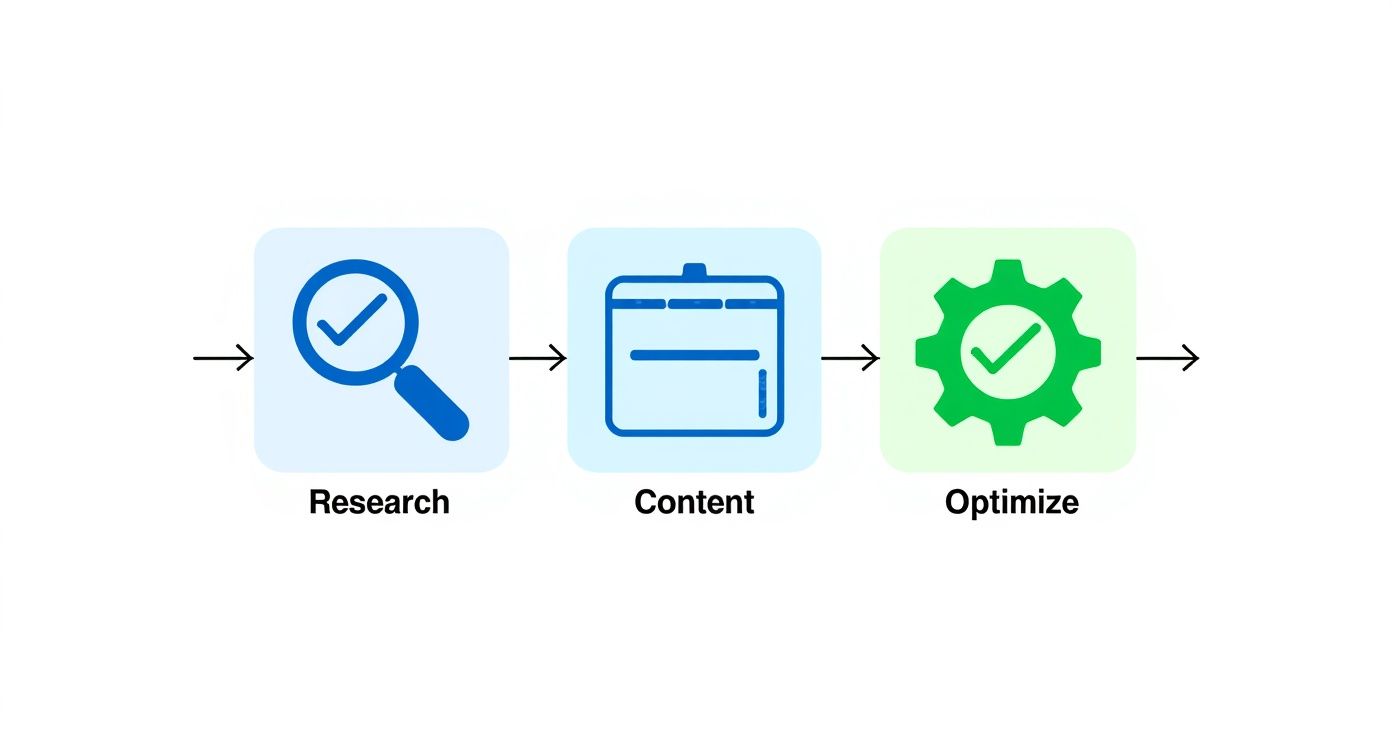
As you can see, ChatGPT becomes the engine driving efficiency from research all the way through optimization, making the entire workflow more connected and fluid.
The key takeaway is simple: AI isn't here to replace SEOs. It’s here to augment our skills, making us smarter and faster. By automating the repetitive stuff, it gives us more time for the creative and strategic thinking that actually moves the needle. To really lean into this, it's worth exploring the top AI workflow automation tools that can work alongside ChatGPT to make your process even smoother.
Tapping AI for Keyword Research and Content Strategy
Keyword research is the bedrock of good SEO, but let's be honest—the old way of wrestling with spreadsheets is a grind. It’s slow, tedious, and you can easily miss golden opportunities. Bringing ChatGPT into the mix changes the game completely, turning a chore into a dynamic brainstorming session. The secret is to stop giving it basic commands and start treating it like a specialized research assistant.
When you give ChatGPT a specific role or persona, you unlock a much higher quality of insight. Instead of just asking for a generic list of keywords, you're framing the request. This simple shift is powerful, helping you generate ideas that are not just relevant, but commercially viable and tuned into what your audience actually needs.
Going Beyond Basic Prompts
To really get the good stuff, you need to think in layers. I like to start broad and then drill down with follow-up prompts, creating a "prompt chain" that refines the output with each step. This method helps you dig way deeper than the surface-level keyword lists most people settle for.
Imagine you're launching a coffee blog for complete beginners. Here’s how that prompt chain might look:
- Initial Prompt: "Act as a market research analyst specializing in the home coffee brewing niche. My target audience is beginners who are overwhelmed by coffee terminology. Brainstorm five main content pillars or topic clusters for a new blog."
- Follow-up Prompt: "For the 'Beginner's Guides to Brewing Methods' pillar, generate a list of 15 long-tail keywords that a novice would search for. Focus on informational intent keywords that answer 'how-to' or 'what is' questions."
See the difference? Right away, you get a structured, intent-driven list, not just a random collection of terms. You aren't just getting keywords; you're building the skeleton of your entire content strategy. To really get the hang of this, you need a solid grasp of prompt crafting. For a deeper dive, check out this a comprehensive guide to modern prompt engineering.
Uncovering Hidden Keyword Opportunities
One of the biggest wins of using ChatGPT for SEO is its knack for spotting semantic connections and user pain points that traditional tools often miss. It’s incredibly good at figuring out the why behind a search query.
Pro Tip: Ask ChatGPT to scrape through online forums or Reddit threads on your topic. A prompt like, "Summarize the top 10 most common problems or questions people have about [your topic] based on forum discussions," can uncover raw, user-generated long-tail keywords you'd never find otherwise.
For example, you could feed it discussions about "cold brew coffee." It will almost certainly pull out highly specific (and valuable) queries like "why is my cold brew bitter" or "best coffee bean grind size for cold brew concentrate." These are the exact phrases that signal high user intent and usually have way less competition. For more workflows on this, our guide on how to generate long-tail keywords that convert has you covered.
Structuring Topic Clusters and Mapping Intent
Okay, so you have a great list of keywords. Now what? The next step is organizing them, and manually grouping hundreds of keywords into logical topic clusters is a nightmare. This is where ChatGPT can save you hours of work. You can lean on its analytical power to build out a full pillar-and-cluster content model.
Here's a prompt I use all the time for this:
"Here is a list of keywords. Group them into semantically relevant topic clusters. For each cluster, suggest a 'pillar page' topic that covers the main theme and several 'cluster page' topics for the sub-themes. Finally, classify the primary search intent (Informational, Navigational, Commercial, Transactional) for each suggested page."
That one command takes a messy keyword dump and turns it into an actionable content plan. It doesn't just group related ideas; it helps you match your content to what the user is actually trying to do—a huge ranking factor. Using this method helps you build a site architecture that Google not only understands but actively rewards with better visibility.
Crafting High-Performance Content Briefs and Outlines
A great article always starts with a great brief. But building one from the ground up—digging for keywords, structuring headings, and hunting down user questions—can feel like a full-time job. This is one of those areas where ChatGPT really shines, turning hours of manual grind into a process that produces better, more focused content.
The goal isn't just about speed; it's about making your briefs smarter. A high-performance brief is a roadmap for your writer. It makes sure the final article is perfectly aligned with what users are looking for and structured to rank right out of the gate, eliminating all the guesswork.
From Simple Idea to Actionable Brief
Let's look at a real-world scenario. You want an article about "home espresso machines." A typical request to a writer might be, "Write 1,500 words on the best home espresso machines." What you'll likely get back is a generic piece that skims the surface and misses key questions your audience has.
Now, let's use ChatGPT to build a proper, SEO-driven brief. Instead of a simple request, we can feed it a detailed prompt designed to pull out every element we need for a comprehensive article.
Here’s a powerful prompt you can use right now:
`"Act as an expert SEO content strategist. Create a comprehensive content brief for an article targeting the keyword 'best home espresso machine for beginners'. The brief must include:
- A suggested H1 title.
- An H2/H3 outline covering topics like types of machines (semi-automatic, super-automatic), key features to look for (grinder, steam wand), budget considerations, and top recommended models.
- A list of 5-7 semantically related LSI keywords to include.
- 5 questions from the 'People Also Ask' section for this topic.
- Suggestions for 2-3 strategic internal links to pages about 'coffee bean types' and 'espresso brewing guide'."`
This one prompt turns a fuzzy idea into a concrete, actionable plan. Your writer gets a solid structure, the right keywords, and critical context, which makes a huge difference in the quality and SEO potential of the final article.
Engineering a User-Centric Outline
The real magic of a ChatGPT-generated brief is the outline. It helps you move beyond just stuffing in keywords and instead build a narrative that walks the reader through their journey, from initial curiosity to making a decision. It’s all about answering their next question before they even think to ask it.
By prompting ChatGPT to include "People Also Ask" questions directly in the outline, you ensure your content addresses the exact queries real users are typing into Google. This is a direct line into your audience's mind and a powerful way to capture featured snippets.
For our espresso machine topic, ChatGPT might suggest H3s like "What's the Difference Between a Steam Wand and a Milk Frother?" or "Do I Need a Machine with a Built-in Grinder?" These are the nitty-gritty questions a generic outline would probably miss. This level of detail is what separates content that just exists from content that actually ranks.
Incorporating Advanced Elements for Better Briefs
Once you're comfortable with the basics, you can take your briefs to the next level by feeding ChatGPT more advanced instructions. This means thinking about how your content fits into the bigger picture of your site.
Here are a few ideas to beef up your prompts:
- Specify a Content Model: Ask ChatGPT to structure the brief using a specific framework, like a pillar-cluster model or AIDA (Attention, Interest, Desire, Action).
- Suggest Entity-Based Keywords: Prompt it to identify key entities (people, places, brands, concepts) related to your topic to improve semantic relevance.
- Request Technical Suggestions: Ask for ideas on where to include tables, infographics, or custom visuals to break up the text and add more value. This is also a great way to target different SERP features.
This kind of detail ensures your content is not just well-written but also technically solid. For more complex content, it helps to understand how the AI is pulling in its information. You can explore techniques like Retrieval-Augmented Generation to see how models use external knowledge for more factual, relevant outputs. For a deeper dive, check out this guide on what Retrieval-Augmented Generation is and how it works. By mastering these prompts, you can consistently produce high-performance briefs that set every piece of content up for success.
Speeding Up On-Page and Technical SEO
When it comes to on-page and technical SEO, the devil is truly in the details. Tasks like writing meta descriptions or generating structured data are critical for getting seen in search results, but let's be honest—they're tedious and incredibly easy to mess up. This is exactly where ChatGPT becomes an SEO's best friend, letting you hand off the repetitive, precision-based work so you can focus on the bigger picture.
Instead of losing hours trying to nail the perfect meta title or fighting with JSON-LD syntax, you can let the AI handle the heavy lifting. This doesn't just speed things up; it ensures every single element is optimized consistently, whether you're working with ten pages or ten thousand.
Crafting Meta Titles and Descriptions That Actually Get Clicks
Your meta title and description are your digital storefront window. They're often your one and only shot to convince someone to click on your link instead of the nine others on the page. They have to be persuasive, accurate, and perfectly optimized, all while fitting into a tiny character box. Writing unique metas for every page by hand is a soul-crushing grind, but ChatGPT can spit out several solid options in seconds.
The trick is giving it enough context. Don't just ask for a "meta description." You have to feed it the target keyword, the page's main point, and the vibe you're going for.
Here’s a prompt I use all the time that gets great results:
"Act as an expert SEO copywriter. Write 3 unique meta titles (under 60 characters) and 3 meta descriptions (under 160 characters) for a blog post about 'how to use chatgpt for seo'. The primary keyword is 'how to use chatgpt for seo'. The tone should be informative and encouraging for an audience of SEO professionals and marketers. The description must include a call to action."
A prompt this specific ensures you get back results that are not just stuffed with keywords but are genuinely tailored to your audience. That's how you boost your click-through rate.
Generating Flawless Schema Markup
Schema markup (or structured data) is the behind-the-scenes code that helps search engines really understand what your content is about, which can earn you those fancy rich snippets in the search results. But writing it by hand in JSON-LD format is a nightmare. One misplaced comma and the whole thing breaks.
ChatGPT is a natural at this. You just give it the information in plain English and tell it to wrap it in the right schema. Whether you need FAQ, HowTo, or Product schema, it’s surprisingly straightforward.
For instance, I'll often just copy and paste three FAQs and their answers from an article and prompt ChatGPT with: "Create valid FAQPage schema markup in JSON-LD format for the following questions and answers." In a few seconds, I have perfectly formatted code that’s ready to be tested and dropped into my site.
This is a complete game-changer for technical SEO. It removes a massive barrier for people who aren't comfortable coding from scratch.
On-Page vs. Technical SEO Tasks with ChatGPT
It's helpful to see how ChatGPT can be applied across both the content you see on the page and the technical signals search engines read in the background. Each requires a slightly different approach, but the goal is the same: making your site more visible and user-friendly.
| SEO Task Type | Specific Task | Sample Prompt Focus |
|---|---|---|
| On-Page SEO | Meta Descriptions | "Write a meta description under 160 characters for a page about [topic], targeting [keyword] and including a call to action." |
| On-Page SEO | Alt Text for Images | "Generate 5 descriptive alt text options for an image showing [image description]." |
| On-Page SEO | Internal Linking Suggestions | "Analyze this text and suggest 3 relevant internal linking opportunities to other articles about [topic A], [topic B]." |
| Technical SEO | Schema Markup (FAQ) | "Create valid FAQPage schema in JSON-LD for the following Q&A pairs." |
| Technical SEO | robots.txt Directives | "Generate a robots.txt rule to disallow crawling of the /private/ directory." |
| Technical SEO | .htaccess Redirects | "Create a 301 redirect rule for an .htaccess file, redirecting /old-page.html to /new-page/." |
As you can see, the prompts shift from a creative copywriting focus for on-page tasks to a very precise, code-generation focus for technical ones. Mastering both is key to a well-rounded SEO strategy.
Tackling More Advanced Technical Directives
Beyond the basics, ChatGPT can also help with more complex technical stuff that usually requires deep expertise. Think generating rules for your .htaccess file to handle redirects or creating custom robots.txt directives to tell search engines where they can and can't go.
Let's say you just finished a site migration and have a spreadsheet of old and new URLs. You can just give that list to ChatGPT and ask it to write the necessary .htaccess rewrite rules. This seriously cuts down on the risk of a syntax error that could knock your entire site offline. The same goes for your robots.txt—just describe what you want to block, and it will write the file for you.
This is becoming more important as the relationship between AI and search evolves. Recent data shows that ChatGPT is driving a huge amount of AI traffic to websites, with that traffic jumping by 85% since January. What's wild is that only 6.82% of ChatGPT's results overlap with Google's top 10, and a staggering 83% of its answers pull from URLs that aren't even on Google's first page. This split shows we need to optimize for AI discovery, where these precise technical signals are absolutely essential. You can dive deeper into these pivotal AI traffic trends on Exploding Topics. When you use ChatGPT to nail your technical SEO, you're not just optimizing for Google—you're getting your site ready for the next wave of AI-driven search.
Scaling Content Creation and Link Building Outreach

Creating a fantastic piece of content is only half the battle. Getting the most mileage out of it is what separates good SEO from great SEO. The same goes for link building; it’s still a cornerstone of authority, but blasting out generic emails is a one-way ticket to the spam folder.
This is where ChatGPT becomes a game-changer. It helps you tackle both of these massive challenges: scaling your content's reach and personalizing your outreach without spending all day on it.
The goal is to shift from a "one-and-done" content mindset to a "create once, distribute forever" model. For outreach, it’s about letting AI handle the initial heavy lifting so you can focus on building actual relationships.
Squeeze More ROI From Your Content
So, you just published an epic, 2,000-word blog post. Don't just let it sit there collecting digital dust. With a few smart prompts, you can spin that single asset into an entire week's worth of content across all your channels.
This doesn't just save a ton of time. It ensures your core message hits different audience segments on the platforms they actually use.
Let's walk through a real-world workflow for repurposing a blog post.
A Simple Prompt Chain for Repurposing:
- Turn it into a video script: "Act as a scriptwriter. Take the key points from the following blog post [paste blog post text] and turn them into a concise, 5-minute YouTube video script. Structure it with a hook, three main points with visual cues, and a call to action."
- Create a social media thread: "Now, transform that video script into a 10-part Twitter thread. Each tweet should be under 280 characters, use engaging language, and include relevant hashtags. Make sure the final tweet links back to the original blog post."
- Draft an email newsletter: "Finally, write a 250-word email newsletter summary of the blog post. Use a compelling subject line, a personal tone, and highlight the single most valuable takeaway for the reader. End with a clear link to read the full article."
Using a chain of prompts like this keeps the brand voice consistent while strategically tailoring the format for each platform. You’re not just copy-pasting; you’re adapting.
Smart and Ethical Link Building Outreach
Nobody responds to "Dear Webmaster" anymore. Effective link building today is all about personalization. The problem is, personalizing hundreds of emails by hand is a nightmare. This is where you can use ChatGPT to personalize your outreach at scale, seriously boosting your success rate.
The secret is giving the AI specific details to work with. Before you even draft the email, you get ChatGPT to analyze your target. This extra step is what makes the final pitch feel authentic.
Crucial Tip: Never send an AI-generated email without reviewing it. Use ChatGPT to create a solid 80% draft, then add your own human touch to get it to 100%. That last little bit of manual effort makes all the difference.
Let's say you're running a broken link-building campaign. Instead of a bland, generic template, your prompt would be much more specific:
"Act as a friendly outreach specialist. I found a broken link on this page: [URL of page with broken link]. The broken link points to [URL of broken link] and the anchor text is '[Anchor Text]'. My article, located at [Your URL], is an up-to-date and more comprehensive resource on this topic. Draft a personalized, non-spammy email to the site owner. Mention a specific point you like about their site to show you've actually read it, then politely point out the broken link and suggest my resource as a replacement."
A prompt like this forces ChatGPT to create a tailored pitch that proves you’ve done your homework. The impact of fine-tuning your outreach for these AI-driven workflows is huge, especially as user behavior evolves. For example, 43% of American adults aged 18-29 have used ChatGPT, making them the most adopted group. As this generation enters professional roles, this kind of personalized, AI-assisted communication will become the norm. You can find more data about these emerging ChatGPT user trends on Concept21.
This approach respects the site owner's time and dramatically increases your chances of earning that valuable backlink.
Got Questions About ChatGPT and SEO? Let's Clear a Few Things Up
Even with all the hype, it's smart to be a little skeptical when you start weaving ChatGPT into your SEO workflow. Honestly, you should be. Knowing where it shines—and where it falls flat—is the key to actually getting results instead of just creating more work for yourself.
Let's tackle some of the biggest questions I hear all the time.
Is Google Going to Penalize Me for Using AI Content?
This is the big one, right? The short answer is: it's complicated, but probably not if you do it right.
Google's official line is that they reward high-quality, helpful content, no matter how it’s made. The keyword there is value. If you're just prompting ChatGPT to spit out generic, 500-word blog posts that say nothing new, you’re creating spam. And spam, whether written by a human or a robot, won't rank.
But that's not what we're doing here. We're using it as a creative partner—an assistant to help us build outlines, brainstorm angles, punch up boring copy, and get a first draft on the page faster. Your expertise is still the secret sauce.
Google isn't fighting a war against AI content; it's fighting a war against bad content. The goal is, and always has been, to create helpful, reliable, people-first content. Your experience and critical eye are what turn a generic AI draft into something genuinely worth ranking.
Think of yourself as the editor-in-chief. AI can be a writer on your team, but you have the final say. The content still has to live up to E-E-A-T (Experience, Expertise, Authoritativeness, and Trustworthiness), and a machine can't fake that on its own.
So, Will ChatGPT Take My SEO Job?
Hardly. It might make parts of your job obsolete, but it's not coming for the whole thing.
While ChatGPT is a beast at handling repetitive, low-level tasks, it completely lacks the strategic mind of an actual SEO. It can’t understand your company's business goals, the nuances of your brand voice, or the competitive pressures you're up against. It has zero business acumen.
Instead of replacing us, AI is just changing the job description. The modern SEO is becoming less of a hands-on-keyboard grinder and more of a strategist—an operator who knows how to direct these powerful tools to get the job done faster and better. Knowing how to use ChatGPT for SEO isn't just a neat trick anymore; it's becoming a core competency that makes you more valuable, not less.
How Much Can I Trust the Information ChatGPT Gives Me?
This is where a healthy dose of paranoia is your best friend. ChatGPT can "hallucinate" with terrifying confidence, meaning it will state completely made-up "facts" as if they were gospel. Its knowledge is also frozen in time, based on when its training data was last updated.
Here are my non-negotiable rules for working with it:
- Fact-check everything. Seriously, everything. Never, ever publish a statistic, date, or technical claim from ChatGPT without finding a primary source to back it up.
- Ignore its keyword data. It cannot give you accurate search volume, keyword difficulty, or any other real-time metrics. That’s what your dedicated SEO tools are for.
- Use it for structure, not substance. It's a fantastic outlining tool. It's a great brainstorming partner. It's a solid first-draft machine. But it's your job to layer in the real, up-to-date expertise.
Treat it like a brilliant but slightly unreliable intern. It's a massive help, but you'd never let it publish something without reviewing it first.
Can Google Tell My Content Was Written by AI?
There are a million "AI detectors" out there, and most of them are unreliable. But honestly, focusing on detection is missing the point entirely.
Google’s main concern isn't about who (or what) wrote the content. It’s about whether that content solves the searcher's problem better than anyone else.
Trying to fly under the radar or "trick" the algorithm is a losing strategy. Pour that energy into using AI as a launchpad to create the best piece of content on the internet for your target query. Add your own unique insights. Include original data or a personal case study. Make sure your article is more thorough, better structured, and more helpful than the current top results.
If you accomplish that, nobody—least of all Google—is going to care how you got that first draft started.
Ready to stop winging it with your prompts? At PromptDen, we've built a massive, community-driven library where you can find, share, and even sell top-tier prompts for SEO, marketing, and everything in between. Ditch the guesswork and start using workflows that actually deliver. Explore our marketplace and take your AI game to the next level today.