
Learn Prompt Engineering Fast Track Guide

Learning prompt engineering isn't just about typing questions into an AI. It's the art and science of communicating with AI models to get exactly what you need, turning a vague idea into a precise, valuable outcome. The process takes you from understanding the fundamentals of how an AI "thinks" to building a solid portfolio of real-world projects. Nail this, and you open up a ton of opportunities in a field that's just getting started.
Why Learn Prompt Engineering Now
The ability to write a great prompt is quickly shifting from a niche tech skill to something everyone needs. It’s the essential bridge between what we want and what the machine does. As more and more businesses bake AI into their workflows, the demand for people who can steer these powerful tools is exploding.
This isn't just a flash in the pan. We're talking about a fundamental change in how we interact with technology. The global market for prompt engineering was valued at a cool USD 222.1 million in 2023, and it's expected to rocket past USD 7 billion by 2030. That kind of growth tells you one thing: companies are desperate for skilled people who can get the most out of their AI investments.
The Core Learning Path
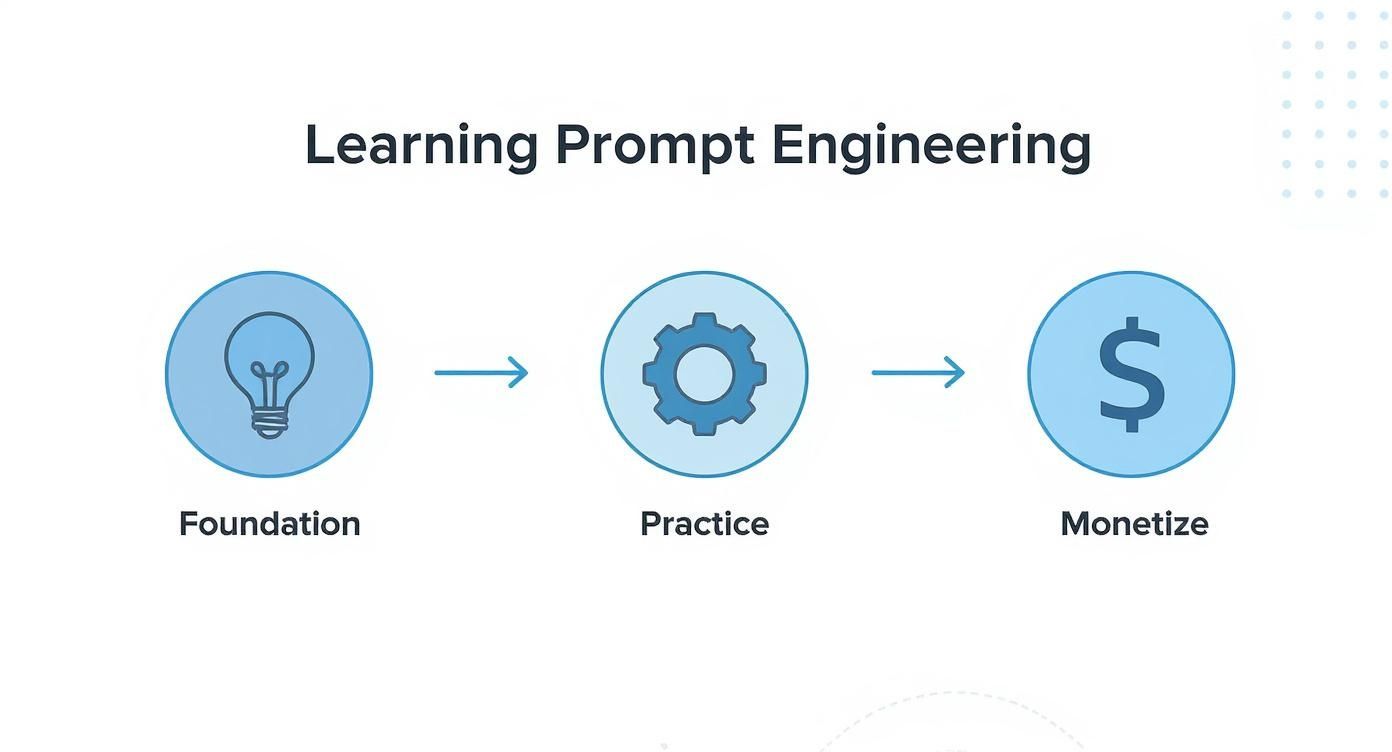
Your journey into prompt engineering will follow a pretty clear path. You'll start with the basics, move into hands-on practice, and eventually, you can even start earning from your new skills.
To help you visualize this journey, I've broken down the key stages you'll go through.
Prompt Engineering Learning Stages
This table outlines the essential steps, from grasping the basics to turning your skills into a career.
| Stage | Key Focus |
|---|---|
| Stage 1: Foundation First | Grasping core AI concepts like tokens, parameters, and model behavior. |
| Stage 2: Hands-On Practice | Experimenting with different models (ChatGPT, Midjourney, Claude) and prompt variations. |
| Stage 3: Advanced Techniques | Learning prompt patterns, chaining, and structured outputs for complex tasks. |
| Stage 4: Building Your Portfolio | Creating projects that solve real-world problems and showcase your skills. |
| Stage 5: Monetization | Exploring freelance gigs, consulting, or full-time roles. Selling prompts on marketplaces. |
Each stage builds on the one before it, giving you a solid, structured way to level up your expertise.
If you're looking for a fun and visual way to get started, image generation is a fantastic place to begin. You get instant feedback on how your words translate into results. To jump right in, check out this practical guide on how to generate images with AI. It's a great first step.
Getting to Grips with Core Prompt Engineering Concepts

Before you can start cranking out powerful prompts, you really need to get a feel for what’s happening under the hood. When you give an AI a prompt, you're not just throwing words at it. You’re providing a specific set of instructions that the model breaks down and interprets. If you're serious about this, your first stop should be a solid primer on What Is Prompt Engineering? to build that foundation.
At the very core of this entire process are tokens. Think of them as the AI's version of Lego bricks for language. An LLM doesn’t see “learn prompt engineering” as three words; it might see it as a sequence of tokens like "learn," "prompt," "engine," and "ering." A decent rule of thumb is that one token roughly equals about four characters of text.
Understanding tokens makes it clear why every single word matters. Each token you feed the AI nudges it down a certain path, steering it through an almost infinite number of possible responses. This is where the real craft of a prompt engineer comes into play—choosing precisely the right tokens to map out a clear route to the exact output you want.
The Building Blocks of a Great Prompt
Once you've got your head around tokens, the next step is learning how to structure your prompts to get different results. You don't need a Ph.D. in data science, but knowing the fundamental approaches will give you an immediate, massive boost.
Most prompt engineering really boils down to three main techniques:
- Zero-Shot Prompting: This is the most straightforward method. You just ask the AI to do something without giving it any examples. Think "Summarize this article." You’re relying completely on the model's existing knowledge to figure it out.
- Few-Shot Prompting: This is where you give the AI a couple of examples of what you're looking for before you make the actual request. This "primes" the model, showing it the format, style, and tone you expect. It's like showing a kid a few solved math problems before giving them a new one.
- Chain-of-Thought (CoT) Prompting: A more advanced tactic, CoT encourages the AI to "show its work." By asking it to break down its reasoning step-by-step, you can walk it through complex problems, catch errors, and get far more accurate answers.
When you get good at these techniques, you stop just asking questions and start programming with natural language. Each method is a tool, and knowing which one to grab for the job is what separates a beginner from a pro.
How a Few Words Can Change Everything
A tiny tweak to your prompt can create a night-and-day difference in what the AI spits out. This sensitivity is something you have to internalize to really learn prompt engineering. Just think about the difference between asking an AI to "Write about dogs" versus "Write a playful, 500-word blog post from the perspective of a golden retriever who is ridiculously excited for his evening walk."
The first prompt is lazy. It’s vague. You’ll get a generic, Wikipedia-style dump of facts. But the second one is loaded with specific instructions:
- Persona: "from the perspective of a golden retriever"
- Tone: "playful," "ridiculously excited"
- Format: "blog post"
- Length: "500-word"
This level of detail leaves no room for guessing and forces the AI down a much more specific, creative path. It’s a skill that's becoming incredibly valuable—the prompt engineering market is expected to rocket to over $7 billion by 2030 as more companies rely on AI.
As you start out, treat every prompt like an experiment. Swap out verbs, play with adjectives, and define the output format. You'll quickly get a feel for how each word acts as a lever, letting you fine-tune the result until it’s exactly what you had in your head.
Getting Your Hands on AI Models and Tools
Alright, you've got the theory down. Now for the fun part: actually making stuff happen. The specific AI model you choose is going to massively change your results. Think of them like different artists—each has a unique style, a set of strengths, and some definite quirks. To really get good at prompt engineering, you have to get out of your comfort zone and see how different models react to the exact same instructions.
You'll probably start with the big names. OpenAI's models, like the various flavors of GPT-4, are the industry heavyweights, known for their creative flair and ability to tackle complex reasoning. Then you have Anthropic's Claude models, which are famous for their enormous context windows and a more conversational, careful personality. This makes them fantastic for chewing through long documents or having a really deep, nuanced chat.
But don't sleep on the open-source world. Models from players like Mistral or the Llama family offer incredible flexibility. They can be fine-tuned for super-specific jobs, though you'll need to be a bit more hands-on with the technical setup. The key is to play around with all of them. This is how you build that gut feeling for which tool is right for the job.
Setting Up Your Workspace
Jumping in is easier than you think. Most of the major platforms have a "playground" environment, like the OpenAI Playground or Anthropic's console, and they're built for exactly this kind of rapid-fire experimentation. They give you a simple box to type your prompt in and, crucially, a few knobs and dials to control how the AI behaves.
You’ll get to know a few key settings really well:
- Temperature: This is the chaos knob. A low temperature (like 0.2) makes the AI more focused and predictable, perfect for getting straight, factual answers. Crank it up to 0.8 or higher, and you're encouraging it to get weird, creative, and take some chances.
- Max Tokens: This one's simple—it’s the maximum length of the AI's reply. It's a critical lever for managing your costs and keeping the output tight and to the point.
- Top P: This is a bit like an alternative to temperature. It tells the model to only pick from the most probable words at each step, which helps rein in a high-temperature model from going completely off the rails.
Think of these parameters as the director's notes for your AI actor. You aren't just giving them a script (the prompt); you're telling them how to perform it—whether to be reserved and precise or bold and imaginative.
Finding the Right Tools and Marketplaces
Once your prompts get more sophisticated, keeping them in a random text file just won't cut it. That's when you bring in specialized tools and platforms to give your workflow some much-needed structure. Prompt management systems are designed to help you version, test, and share your prompts, whether it's with your team or the whole world.
Platforms like PromptDen pull double duty as both a toolkit and a marketplace. You can discover incredible, high-performing prompts that others have already perfected, which can save you countless hours of banging your head against the wall. More importantly, you can organize your own prompts into neat libraries, making them easy to grab and tweak for different projects.
This kind of organized approach is a lifesaver when you're building larger applications that need consistent, reliable AI outputs. You might have one set of prompts for generating slick marketing copy and a completely different, more technical set for writing user documentation.
You can even take it a step further and connect your prompts to external knowledge bases for hyper-relevant answers. To see how that works, check out our guide on what is Retrieval-Augmented Generation for a practical look at this powerful method.
Designing Effective Prompts With Proven Patterns

This is where you move beyond basic instructions and really start to learn prompt engineering. Instead of trying to reinvent the wheel for every single task, you can lean on established prompt patterns—these are battle-tested templates that consistently produce reliable, high-quality results.
Think of them less as "magic words" and more like proven recipes. You could just throw a bunch of ingredients in a pan and hope for the best, or you could follow a recipe that guides you to a great meal. Prompt patterns are your recipes for getting predictable, impressive outputs from any AI.
The Power Of Role Prompting
One of the simplest yet most powerful patterns is role prompting. All you do is assign the AI a specific persona or area of expertise before you give it the task. This one move instantly narrows the model's focus, guiding it to pull from the most relevant parts of its massive training data.
It's the difference between a vague request and a professional directive.
- Weak Prompt:
Write a product description for new running shoes. - Strong Role Prompt:
Act as an expert e-commerce copywriter specializing in athletic footwear. Your tone is energetic and motivational. Write a 150-word product description for the new "AeroRun Pro" running shoes, focusing on their lightweight design and responsive cushioning.
That simple shift provides critical context, sets the tone, and establishes a clear objective. The AI is no longer a generalist; it's a specialist you've "hired" for a specific job, and the quality of its output will jump accordingly. This is a foundational pattern for getting more professional results.
Structuring Complex Requests With Chain-of-Thought
When you're dealing with problems that require reasoning or multiple logical steps, Chain-of-Thought (CoT) prompting is your go-to pattern. It works by simply asking the model to "think out loud" or break down its reasoning process before delivering the final answer.
This approach forces the AI to follow a logical sequence, which drastically cuts down on errors in more complex tasks. If you were trying to solve a tricky logic puzzle, you wouldn't just ask for the answer. You'd add a phrase like, "Let's think step by step."
This nudges the model to lay out its process, something like this:
- First, I need to identify the core constraints of the puzzle.
- Next, I'll evaluate each possibility against those constraints.
- Finally, I'll state my conclusion based on that step-by-step analysis.
This transparency doesn't just improve accuracy; it also lets you see the AI's "thinking" so you can debug it if it goes off course. It turns the AI from a mysterious black box into a genuine collaborator.
The core idea behind patterns isn't to trick the AI. It's to communicate with clarity and precision, guiding the model toward the desired outcome by removing ambiguity and providing a clear path to follow.
Layering Examples With Few-Shot Prompting
Sometimes, showing is just plain better than telling. That's where few-shot prompting comes in. This pattern involves giving the AI a handful of examples of the input-output format you want before you make your real request.
It’s incredibly powerful for tasks that need a very specific structure, like extracting data or reformatting text. You’re essentially fine-tuning the model on the fly for your exact need.
For instance, if you want to pull full names from messy sentences:
Prompt: `Extract the full name from each sentence.
Sentence: "I spoke with Jane Doe about the project." Name: Jane Doe
Sentence: "The report was submitted by John Smith." Name: John Smith
Sentence: "We need to get approval from Mary Allen." Name:`
By providing clear examples, you're teaching the model the precise pattern to follow. If you want to go deeper, our guide on mastering few-shot prompting for better AI results covers more advanced strategies. This method is a cornerstone for building scalable and dependable AI workflows.
Measuring and Refining Your Prompts
Crafting a killer prompt is rarely a one-and-done deal. It's an iterative process. A prompt that works perfectly with one model might need a few tweaks for another. The secret is to test your results systematically.
Start with some simple A/B testing. For the same task, create two different versions of a prompt. Run each one several times to see which performs more consistently. You can even score the outputs on a simple 1-5 scale based on relevance, accuracy, and how well it followed your instructions.
This data-driven approach takes the guesswork out of the equation and helps you build a personal library of proven, high-performing prompts you can rely on for any project.
Structured Practice And Real World Projects

Moving from theory to hands-on work is where everything clicks. You can read about prompt patterns, but nothing beats rolling up your sleeves and solving actual problems. This is the stage that forges your muscle memory in prompt engineering.
The real aim? Developing an instinct for how different models react to your phrasing. You’ll cycle through prompting, assessing, tweaking—over and over—until writing effective instructions feels second nature.
Foundational Prompting Drills
Begin by isolating the core skills you’ll return to time and again. These short, focused exercises sharpen your eye for clarity, context, and structure.
- Text Classification: Feed the model 20 customer reviews and aim for 95% accuracy in tagging sentiment as positive, negative, or neutral. Try a zero-shot prompt first, then layer in a few examples to see your score climb.
- Summarization Challenges: Take a 1,000-word article and write two distinct prompts: one that condenses it into bullet points for a C-suite audience and another that dives into implementation details for a technical manager.
- Data Extraction: Supply a messy paragraph of names, dates, and addresses. Your goal is to coax out a clean JSON object. This drill is fundamental for any automation pipeline.
These drills force you to reckon with vague instructions and hallucinations. Each misfire shows you exactly what to refine next.
From Exercises To Portfolio Projects
Once the basics feel routine, it’s time to prove you can tackle bigger challenges. Building a portfolio project demonstrates you’re not just following recipes—you’re creating solutions.
Choose something that excites you to stay motivated. Document every stage: the initial prompt, the missteps, the fixes, and the final result.
A compelling portfolio narrates problem-solving, underlining each iteration and insight rather than just listing polished prompts.
Project Blueprints To Get You Started
Here are three project ideas that mirror real business needs. Each one delivers a concrete outcome you can showcase to potential employers or clients.
- Customer Support Chatbot Brain• Objective: Craft a master prompt that gives the AI a friendly support-agent persona, access to your product database, and clear escalation rules.• Key Challenge: Blend conversational tone with accurate fact-retrieval—and never promise what you can’t deliver.• Portfolio Showcase: Present a series of dialogue logs highlighting how your logic handles queries from “Where’s my order?” to tricky refund requests.
- Automated Report Generation Engine• Objective: Chain prompts to transform raw CSV data (sales figures, web analytics) into a narrative summary.• Key Challenge: Break the task into digestible steps—data analysis, executive summary, and visual call-outs.• Portfolio Showcase: Show a side-by-side comparison of raw numbers versus an AI-crafted report that reads like a pro’s written memo.
- Personalized Content Recommendation System• Objective: Let users input their favorite books, movies, or artists and generate five new recommendations complete with brief justifications.• Key Challenge: Teach the model to spot themes and styles so connections feel creative, not random.• Portfolio Showcase: Build a simple web interface where visitors can explore recommendations in real time.
Completing any of these will boost your confidence and give you a tangible asset. More importantly, you’ll prove you can move beyond theory to deliver real-world results.
Monetization And Community Engagement Strategies
Once you've gotten your hands dirty with structured practice, it’s time to think bigger. Your ability to write sharp, effective prompts isn't just a cool party trick—it's a seriously valuable skill, and the market is waking up to that fact. This is where the hobby becomes a potential career.
You can start by dipping your toes into freelance platforms. Businesses are constantly on the lookout for specialists who can fine-tune their AI workflows. At the same time, more companies are creating full-time, in-house roles for prompt engineers because they know expert guidance is the key to getting a real return on their AI investment.
Turning Prompts Into Profit
Beyond a traditional 9-to-5, you can package your expertise into products people will actually buy. Think about creating specialized prompt libraries for niche industries—like real estate agents or e-commerce marketers—and selling them on marketplaces. It’s a great way to build a stream of income from work you do once.
Consulting is another powerful route. Many businesses are struggling to figure out how to integrate generative AI effectively, and your skills can help them build efficient systems from the ground up. If you're looking for some direct, no-fluff ideas to get started, our article on how to make money with AI offers a practical guide and lays out some actionable steps.
The real value isn't just in writing a single great prompt. It's in your ability to create scalable, repeatable systems that deliver consistent results, saving businesses significant time and resources.
Don't underestimate the power of building an online presence, either. Sharing what you learn on a blog or social media positions you as a go-to expert in the space, which often leads to opportunities finding you.
Building Your Career And Network
The demand for skilled prompt engineers isn't just growing; it's exploding. LinkedIn job postings that mention 'prompt engineering' have shot up by an incredible 434% since 2023. That’s a massive signal of where the industry is heading.
This isn't just hype, either. The numbers back it up: certified prompt engineers can command salaries 27% higher than their non-certified peers. With 68% of firms now providing internal AI training, the message is loud and clear: this skill is becoming non-negotiable. You can read more about the vital role of prompt engineering in today's market on CMSWire.com.
Want to give your credibility a boost? Look into getting certified or contributing to open-source AI projects. These aren't just lines on a resume; they're proof to potential employers and clients that you know your stuff.
Getting involved in the community is just as crucial. Hanging out in forums and online groups gives you an edge.
- Stay Current: AI moves at lightning speed. Communities are the best place to hear about new models, tools, and killer techniques the second they drop.
- Collaboration: Team up with other engineers on shared projects or toolkits. It’s an amazing way to learn from others and grow your network.
- Feedback: Get honest, constructive criticism on your prompts from people who have been doing this for a while. It’s the fastest way to sharpen your craft.
Seriously, networking with other pros keeps you from falling behind and opens doors to jobs and collaborations you’d never find on your own.
Got Questions?
As you dive into prompt engineering, you'll find that some questions come up over and over again. Here are some quick answers to the common hurdles I see people facing when they're just getting started.
Which AI Model Should I Actually Use?
The honest answer? It completely depends on what you're trying to do.
If you're tackling something creative or a task that requires deep, complex reasoning—like writing a detailed story or analyzing a legal document—you'll want to reach for a frontier model like GPT-4 or Claude 3 Opus. Their advanced capabilities are worth the extra cost here.
But for simpler jobs like categorizing customer feedback or pulling names from a block of text, a smaller, faster model is often the smarter choice. Something like GPT-3.5 Turbo or an open-source option from Mistral will get the job done efficiently without racking up a huge bill. My advice is always to define your task first, then run the same prompt through a couple of different models. It’s the only real way to compare their speed, cost, and the quality of what they spit out.
How Do I Stop The AI From Just Making Stuff Up?
Ah, the infamous AI "hallucination"—when a model confidently states something that's complete nonsense. It's a common problem, but you can definitely rein it in by grounding the AI in facts and dialing back its creative freedom.
A few things work well here:
- Give It a Source: Don't let it pull from its vast, murky training data. Instead, provide the specific documents or data you want it to reference directly in your prompt.
- Use a Persona: Tell it to act like an expert who values accuracy above all else. Role-prompting can have a surprisingly big impact on output quality.
- Turn Down the "Temperature": This is a technical setting, but it's super important. Set the temperature parameter to a low value (like 0.2) to make the AI's answers more focused and less random.
The single most effective trick I've found to fight hallucinations is to add this simple line to my prompt: "If you do not know the answer, say you do not know." It works wonders for improving reliability.
What's The Best Way To Know If My Prompts Are Any Good?
Evaluating your prompts shouldn't be a random process based on a gut feeling. A little bit of structure goes a long way.
I recommend creating a small test set with a few different inputs and running them all through your prompt. Then, grade each output on a simple 1-5 scale across a few key areas:
- Accuracy: Was the information correct and factual?
- Relevance: Did it actually answer the original request?
- Adherence: Did it follow all your instructions (like format, tone, or word count)?
When you track these scores as you tweak your prompt, you start making data-driven improvements. It’s the difference between guessing and engineering.
Ready to stop guessing and start building? PromptDen gives you access to thousands of high-quality, community-vetted prompts for every task imaginable. Find what you need, test it instantly, and organize your prompt library all in one place. Explore the marketplace and start creating better AI outputs today.