
What is chain of thought prompting: Explore AI reasoning

Ever ask an AI a question and wonder how in the world it came up with that answer? Imagine asking it a tricky math problem, but instead of just getting the final number, you see every single step of the calculation laid out right in front of you.
That’s the simple idea behind Chain of Thought (CoT) prompting. It's a method that nudges an AI to explain its reasoning step-by-step, rather than just spitting out a final answer.
Unlocking the AI's Inner Monologue
Chain of Thought prompting is really about getting the AI to "think aloud." This whole approach blew up when researchers from Google Brain introduced it back in 2022. Instead of just demanding an answer, you ask the model to show its work, almost like a human would. You can dive deeper into their original research findings to see how it all started.
This simple shift in how we ask questions has a couple of massive benefits:
- Better Accuracy: It forces the AI to break down complicated problems into smaller, more manageable pieces. This dramatically cuts down on silly mistakes and improves the final result.
- More Transparency: You can actually follow the AI's logic. Seeing how it connects the dots makes it way easier to trust the answer—or spot exactly where it went wrong so you can fix it.
This technique is a cornerstone of the broader field of Prompt Engineering, which is all about crafting the perfect inputs to get what you want out of an AI. By getting a handle on CoT, you’ll be on your way to getting far more reliable and logical answers from any model you work with.
How Chain of Thought Prompting Actually Works
So, how do you actually get an AI to show its work? It's simpler than you might think. The most direct method is called Zero-Shot CoT. All you have to do is add a simple phrase like "Let's think step by step" to the end of your prompt. That little nudge is often enough to encourage the model to break down its reasoning before giving a final answer.
If you need a bit more control, you can step it up to Few-Shot CoT. With this technique, you give the AI a full-blown example to learn from—a complete problem paired with a step-by-step solution. This essentially hands the model a perfect template to follow when it tackles your actual query. If you want to get good at creating these, it's worth taking the time to master few-shot prompting for better AI results.
The infographic below really brings this to life, showing how CoT prompting turns a standard question into a much more structured and logical process.
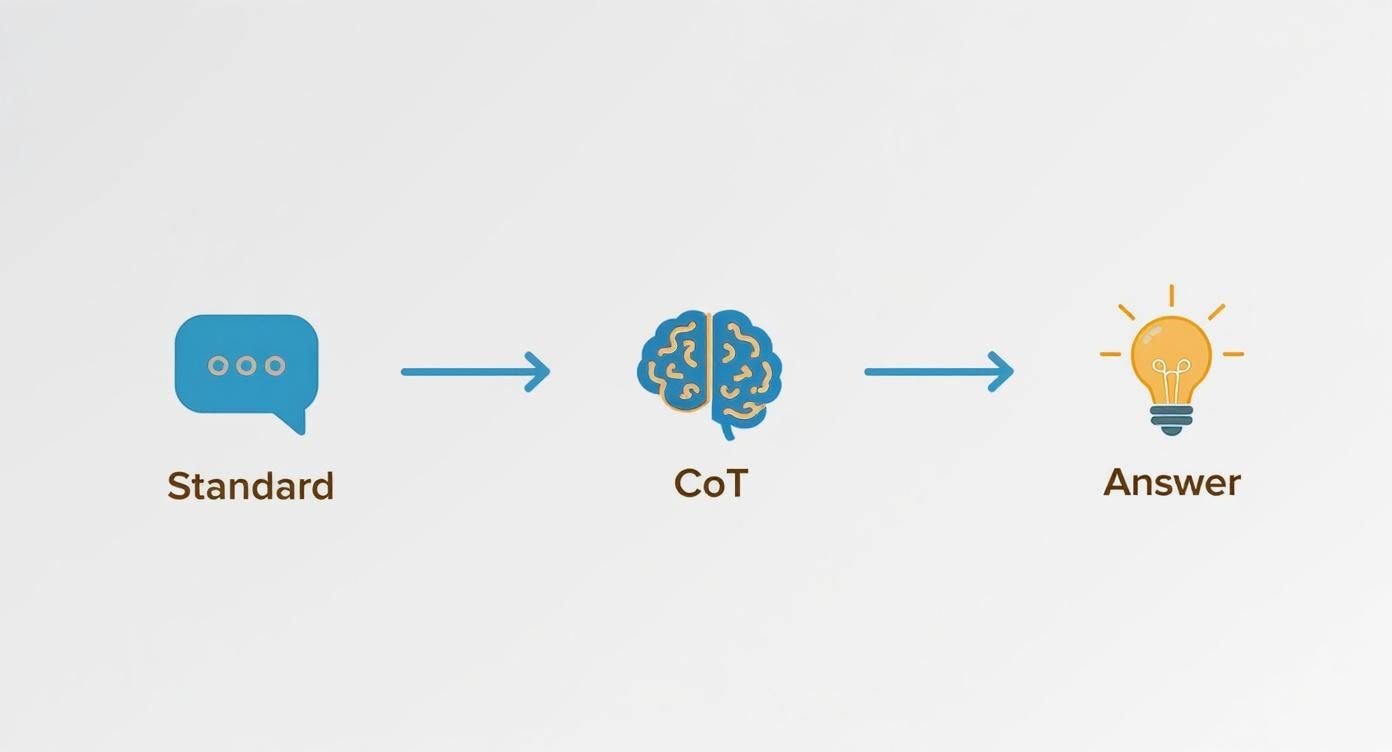
This whole approach really took off around 2022 when researchers noticed that getting an AI to mimic human-like problem-solving dramatically boosted its accuracy and made its thinking process way more transparent. It was a simple but powerful shift in how we communicate with these models.
Why Bigger Models Reason Better
Ever notice how chain-of-thought prompting works wonders on some AI models but completely falls flat on others? It’s not just you. The secret sauce is almost always the model's size.
This all comes down to a fascinating concept in the world of large language models (LLMs) called emergent abilities. Think of it like a student trying to tackle advanced calculus before they’ve even mastered basic algebra—it just won’t work. An AI model needs to hit a certain scale and complexity before it can truly "think" step-by-step.
In fact, this boost in reasoning is really only seen in models that cross the 10 billion parameter threshold. This isn't something developers program directly into the AI; it's an ability that emerges after being trained on absolutely massive amounts of data. You can dive deeper into the research behind these emergent abilities on hdsr.mitpress.mit.edu.
That's why CoT is a technique built for the big leagues—the most powerful models out there. For a great example of a model where this works well, check out our overview of Google Gemini features and impact.
Real-World Benefits of Showing the Work

Using chain-of-thought prompting isn't just a neat trick; it delivers concrete advantages that give you more confidence and control over how you work with AI. The payoff is much bigger than just getting a slightly better answer.
Improved Accuracy
First things first: accuracy gets a major lift. When you force the model to break down complicated problems—especially with things like math, logic puzzles, or instructions with multiple steps—the chances of it making a simple mistake go way down.
Enhanced Transparency and Trust
When an AI shows its work, you get a window into its reasoning process. This transparency is huge because it lets you check its logic, spot any errors, and ultimately trust the final output a lot more.
You can pinpoint the exact moment the AI's logic went off the rails. That empowers you to tweak your prompt and get a much better result the next time around.
Putting Chain of Thought into Practice

Alright, let's move from theory to reality. Chain-of-thought prompting really shines in any task that requires more than one logical step to solve. This makes it incredibly useful across all sorts of different fields.
Its core strength is breaking down complex problems into manageable pieces, which is exactly what you need for tackling real-world challenges.
Think about complex problem-solving. CoT helps an AI navigate those tricky math or science questions that demand careful, step-by-step deduction. In content creation, you could use it to generate a well-structured article by first prompting the model to outline the main arguments and then flesh them out.
Even in code generation, a developer can ask an AI not just to write a function, but to explain its logic for writing it. This makes troubleshooting a whole lot easier because you're not just looking at the code; you're seeing the roadmap that created it.
Chain of Thought Prompting Use Case Examples
To give you a clearer picture, here’s a breakdown of how this technique applies across different domains. The table below shows just a few examples of how versatile CoT prompting can be for getting more reasoned, accurate outputs from an AI.
| Domain | Example Task | Benefit of CoT |
|---|---|---|
| Mathematics | Solving a word problem involving multiple calculations. | Shows each step of the calculation, making it easy to spot errors. |
| Software Development | Debugging a piece of code that throws an error. | The AI explains its diagnosis and the logic behind the proposed fix. |
| Content Creation | Writing a long-form blog post on a complex topic. | Generates an outline first, then writes each section, ensuring logical flow. |
| Scientific Research | Summarizing the findings of a dense academic paper. | Breaks down the methodology, results, and conclusion sequentially. |
| Customer Support | Creating a troubleshooting guide for a common product issue. | Outlines the step-by-step process a user should follow to resolve their problem. |
As you can see, the common thread is turning a single, complex request into a series of smaller, logical thoughts. This simple shift in prompting can dramatically improve the quality and reliability of the AI's output, no matter what you're working on.
Writing Prompts That Guide Great Reasoning
Ready to start crafting your own CoT prompts? The secret sauce is clarity.
You have to be explicit. Guide the AI’s process with direct instructions like, “Explain your reasoning step by step before giving the final answer.” Vague requests are the quickest way to send the model off the rails—it’s a surprisingly common pitfall.
If you’re using few-shot prompts, make sure your examples are rock-solid and logical. A confusing or flawed example just teaches the AI bad habits, which completely defeats the purpose.
Ultimately, getting good at this is all about sharpening your general prompt writing skills. For a deeper look at the fundamentals, check out our guide on how to write prompts for better AI results. You can also find some great external perspectives with these tips for writing AI prompts that deliver better results.
Still Have Questions?
You're not alone. When you start digging into chain-of-thought prompting, a few common questions always pop up. Let's tackle them head-on.
So, When Should I Actually Use Chain of Thought?
Think of CoT as your go-to tool for any task that needs more than a one-step answer. It really shines when you're dealing with problems that involve multi-step logic, calculations, or any kind of complex reasoning.
For simple stuff like pulling a specific fact or asking for a straightforward creative snippet, standard prompting is usually all you need and will get you there faster.
Does This CoT Trick Work with All AI Models?
Not exactly. This technique is most effective with the big players—the large-scale models that have enough training under their belts to develop what we call emergent reasoning abilities.
If you try this with smaller or less advanced models, you might find they can't quite follow the step-by-step instructions. The results can get a bit wonky and unreliable, so it's best to stick with the more powerful models for CoT.
Can Chain of Thought Prompting Still Be Biased?
Yes, absolutely. While CoT is fantastic for making an AI's reasoning transparent, it's not a magic wand for bias. The individual steps in the AI's "thought process" can still reflect biases baked into its original training data.
The key advantage here isn't eliminating bias entirely, but making it visible. That transparency makes it much easier for you to spot, question, and ultimately correct any biased logic you find in the model's output.